
In our school, this is the season of report cards. It seems as though, for staff, that they have been in process for about a month.
In just a couple of days students and their parents will open the envelopes of doom the assessments of work, behavior and effort. There will be praises and punishments resulting from these pieces of paper. There will be triumphant cries, and tears. There will be rewards and removals of privileges.
But …
do the report cards report on learning?
That is the question of the day, within the hallowed halls of educational places all over. The traditional methods of assessing learning are being looked at from every angle. As with many traditional practices in a variety of areas of life, what is done because it has always been done that way, assessment is being evaluated.
When we read a report card, there are (generally) two important parts:
- the mark … be it a number or letter representing a range of understanding
- the comment … included within may be effort, behavior, an example of a situation
The mark often represents how the student has done on tests, homework and assignments. The comment can be quite subjective, reflecting the relationship between the student and teacher, as well as the observations of the teacher.
These are okay assessments … not all bad. They are not, though, complete indicators of learning.
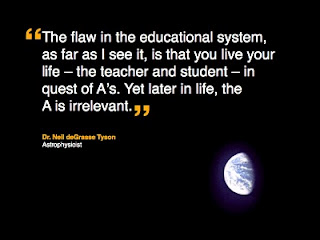
The following image/quote would reverberate for most teachers, school administrators, educational assistants:
 Oh sure, there are a few educators who are just in it for the money (insert extreme laughter here), the long summer breaks or who simply got into the wrong profession. But those are the rare exception, not the norm.
The desire of the educator, who is called to their work. is not that a piece of paper, handed out two or three times a year, define a student. The greatest desire is that each student learn. That each student succeed, in some way (maybe not even academically), in their life. That each student know what their passion is, and how to make it their life’s work.
Truly gifted and called educators care more about who the student becomes, rather than what the report card assesses.
May we parents all, before opening that report card, look our children in the eyes and say, “I love you. I love who you are and who you were created to be. Opening this report card will not change that reality.”

 Recently I was asked if I could share with another person what I do when teaching Life Skills to students, and I immediately became self-conscious and intimidated at the thought of having to put what I teach into words.
 in it for me. Verse 7 states, “(there is a time for everything, and a season for every activity under the heavens:) a time to be silent and a time to speak.” When the words settled in my ears, I realized that maybe I had been silent for a reason that came, not from weakness, but from a holy, seasonal balance. Maybe this was my time to be silent?
 he would have liked me to have learned from him in that time 😉 .
 y took in a boy who needed a family, and made him fully part of theirs. They dealt with a fire, drought, poverty and Nelie Olsen! The show dealt with real life issues that are not relegated to the Prairie, such as death, poverty, alcoholism, thievery, adultery, illness, and single parenting, just to name a few.
 as “The Waltons” who introduced me to another time in history. They also taught me about a family who loves each other. There lives were tough, and life did not always go as they would have liked. They lived in a multi-generational house, had a home business, and almost everyone under the roof was a type A, strong willed personality. The show dealt with real life issues, not relegated to the time of the Depression to WWII in the mountains of Virginia. They dealt with issues such as death, poverty, alcoholism, abuses, a house fire, and single parenting.
 ng the viewer to tears from laughter as well as from touching scenes. They taught me about a family who loves each other. Although they were a family of means (he, an obstetrician and she, a lawyer), they still lived a life of issues that the typical family could face. They dealt with death, marital stress, teen alcohol use, two income family dynamics, and many child rearing issues.
 Happy Days was another of our favorites. The music was so great, and the it had the bonus of dealing with everything from the serious to the absurd (sort of like my blog). The show taught me about a family who loves each other. They were an average middle class family dealing with the average middle class life issues. Issues such as death, marital problems, stealing, heartbreak, and various teen-related issues. It took us back to a day and time when the man brought home and bacon and the woman cooked it up. Don’t think that Marion Cunningham was a spineless woman though, because, although hubby Howard was the head of the family, Marion was definitely the neck that turned that head!
 teacher interviews, always included, “she talks a lot in class” … okay, maybe not ‘ideal’ 😉 ).











 itsawonderfilledlife