Feeds:
Posts
Comments

Archive for the ‘Walking with God’ Category

Have you ever tried really sour candies? You know, the kind that makes your tongue roll back in your mouth and your lips pucker and your eyes squint. After having such a rude sour experience, tasting something sweet seems even more sweet, more enjoyable.

In Italian the sweet life is translated, la dolce vita. In contrast the sour life is translated la vita acida. Those translations make sense as I say them, for acida sounds so … acidic.

Contrasts such as sour and sweet make me think of the book of Ecclesiastes.

Recently, while on vacation, I sought out the following verse from Ecclesiastes, as it’s meaning kept echoing throughout our time away:

“On a good day, enjoy yourself;
On a bad day, examine your conscience.
God arranges for both kinds of days
So that we won’t take anything for granted.”

Ecclesiastes 7:14 MSG

Our vacation was day, after day, after day of good days. We heard good speakers, ate delicious foods, saw beautiful sights, walked in the sun and on the sand, caught up on the lives of friends, rested, laughed frequently, planned, dreamed and simply loved each other. It was pure delight.

It is a place we visit annually … but every year is not equally good.

Some years there are things that hinder the good of the day(s). Maybe we were particularly tired, or preoccupied, or ill, or not one with each other in a multitude of ways. Those are the the bad days.

I much prefer the good to the bad days. They simply feel so … good.

One reason that they feel so good is that I also know what it is to have bad days. Those days when we just do not connect, when our joy is drowned out by the dark and twisties of real, human life. When the beauty and blessing around us is shadowed by the other, darker side of human existence.

I love the reminder that Solomon gives us that “on a good day, enjoy yourself.” There is nothing said about feeling guilty when good comes our way, no condemnation for a day of blessings … just the instruction to experience it, for what it is … good … sweet! When la dolce vita is your experience of the day (or season) take joy in it!

Just a chapter later, seems to be affirmation of enjoying the sweet life:

“a man hath no better thing under the sun,
than to eat, and to drink, and to be merry”
(Ecclesiastes 8:15)

The line that follows intrigues me in that it contrasts the sweet life, with a bit of acid, “on a bad day, examine your conscience.” In this translation, examine is often replaced with consider, but in the Hebrew the verb is raah (pronounced raw-aw) and it means to see. So another way to read this line might be “on a bad day, take a look at your life.”

When things are bad, it can be a season to reflect on where our priorities are and a chance to rely on the faithfulness of God, in bad times of the past. We often learn and grow during sour times.

I hear Job (2:10) asking “”shall we receive good at the hand of God, and shall we not receive evil?”

There is a harmony that is given when we experience both the sweet and sour, the good and bad. The good gives us energy for the bad, the bad gives us joy in the good. Having the experience of both reminds us to not take the good days for granted, but to be thankful for the times when life is sweet.


Read Full Post »

One of my favorite theologian’s name is Laverne.

She is female, I think. I do not know her age. I presume her to be Catholic. She is wise, and funny, and sarcastic (oh, how I do love sarcasm). She is not human. She is not even alive. She, my favorite theologian, is Laverne, one of the three gargoyles from the Disney movie, The Hunchback of Notre Dame (and the only one whose voice comes from a female).

Some of the things that she taught me are :

“… take it from an old spectator. Life’s not a spectator sport. If watchin’ is all you’re gonna do, then you’re gonna watch your life go by without ya.”

these (physical) chains aren’t what’s holding you back”

“We just thought maybe you were made of somethin’ stronger.”

“Fly, my pretties! Fly, fly!”

But my favorite teaching from Laverne the theologian was, “nobody wants to stay cooped up here forever.” She says this to the bell ringer, Quasimodo, who had spent his life being ‘safe’ in his cathedral tower. Inside the walls of the church he had all he needed. He had friends (the gargoyles), he had food, and clothes, and … sanctuary. He was protected from the evils outside of the walls of Notre Dame.

But, was he living? Was he fulfilling his purpose?

It was not until Quasimodo left the sanctuary of his bell tower that he could taste and see what life among the living was like. It was in learning to risk, and love and lose that he learned that he had something to bring to the world, beyond the safety of his church walls.

For me, this lesson is one that I want to hold on to. I too enjoy the sanctuary of my church. But, it is in my leaving this place of sanctuary, that I bring what I have, in Christ, to the world. If I stay ‘cooped up (at church) here forever’ I then am not allowing God to use me, as his vessel through which he might speak to those yet to choose life with him.

When we, who profess the Christian faith, surround ourselves with only those who share our belief system, we have forgotten the words of Jesus:

“And then he told them, “Go into all the world and preach the Good News to everyone.” Mark 16:15

This is the great commission, this is our commissioning, from Jesus, to take his word, his light into the world … it is why we are here, our purpose.

So, I challenge those of you (and me) who find sanctuar

Read Full Post »

I haven’t met many mornings that I didn’t immediately love.

I love the excitement of the sun rising, of a fresh new day (with no mistakes in it, as Anne of Green Gables would say), the fresh energy that courses through my body and the reminder of walking with God in the very beginning.

In Proverbs (8:17), we are told:

“I love them that love me:
and they that in the morning early watch for me,
shall find me.”

As my day begins, I am eager to connect with God.

For hubby … not so much, or, more specifically, not so early.

I am pretty certain that hubby has never and will never see God early on any morning. Just a few days ago, as we were listening to a speaker, he reminded us of another Proverb (27:14):

“A loud and cheerful greeting
early in the morning
will be taken as a curse!”

Hubby heard it too and raised his eyebrows at me … I think I am going to be hearing this verse quite a bit.

As we have been vacationing at the coast, going to sleep and awaking each day to the sounds of the surf and the seagulls, my love of mornings has reached new heights. I simply cannot wait to peek through the blinds to see the waves crashing against the sandy shore. Each morning here I rise with the song it’s A Beautiful Morning playing in my brain.

The aesthetic beauty here is awe inspiring and it provides ample opportunity for creativity, renewal and rejuvenation.

But it is that morning glow … of my soul, that awakens a part of me beyond the typical dawn. This is a benefit that comes from experiencing summer sabbath rest, away, in the midst of beauty, and solid teaching, and good friends, and good food. It is like having the freshness of a new day, on steroids.

The other day someone reminded me of something from the creation account, that I had not thought of, before. Adam and Eve were the end of God’s creation week activities, truly they/we are his pièce de résistance … his greatest work. The day following that human creation was the day of rest, the sabbath.

Before Adam and Eve had to work, they rested. Imagine how spectacular their first morning, after their sabbath, felt for them! It made me realize we do not rest to get over our day, but we rest, in preparation for the new day.

“It’s a beautiful morning
I think I’ll just go outside for awhile
And smile”

“Every morning
he makes me eager
to hear what he is going to teach me.”

Isaiah 50:4

Read Full Post »

Hubby and I … well, it is probably best said that opposites attract.

We have differing points of view on everything from coffee shops, to music, to movies, to politics, to child rearing, to chocolate (he says milk and I say dark). These different perspectives can leave us frustrated, angry and even with hurt feelings. What they don’t do is ignite hate for each other.

What we share together is far greater than on what we differ. Oh, the differing can be immensely challenging and even hurtful, but we share a life-guiding principle …

we love one another

The concept of loving one another came from the mouth and heart of Jesus, himself. It was while sitting around a table with his eleven (Judas had already stepped away … in more ways than just physically stepping away), that Jesus commanded them to love one another.

“A new command I give you: Love one another. As I have loved you, so you must love one another. By this everyone will know that you are my disciples, if you love one another.” (John 13:34-35)

This loving each other was as foreign a concept then, as it is now. Like today, when people eliminate or unfriend people who think differently than us, society in the time of Jesus was also more about about assimilation than about community or love.

The Matthew Henry Commentary (MHC), on this love one another passage says,

“Laws of revenge and retaliation were so much in vogue, and self-love had so much the ascendant (superiority), that the law of brotherly love was forgotten as obsolete and out of date; so that as it came from Christ new, it was new to the people.”

So when Jesus delivered this command (not a suggestion, but a command) it was counter culture, odd and new. It could have been dismissed completely had he not given them a model to follow … himself.

Jesus told them to love each other “as I have loved you.”

Each one sitting there, listening to him speak would know, by their experience and intimate knowledge of life with him, how high the bar was that Jesus had set for them.

As the MHC says, of his example of what it is to love one another:

“He spoke kindly to them, concerned himself heartily for them, and for their welfare, instructed, counselled, and comforted them, prayed with them and for them, vindicated them when they were accused, took their part when they were run down, and publicly owned them to be dearer to him that his mother, or sister, or brother. He reproved them for what was amiss, and yet compassionately bore with their failings, excused them, made the best of them, and passed by many an oversight. Thus he had loved them, and just now washed their feet; and thus they must love one another, and love to the end. “

This is what we are called to, as well.

None of this would have been a surprise to the disciples, anymore than it should be a surprise to us, today.

Jesus did not give up on his disciples. He did not unfriend, nor did he cease to love each and every one (Judas included), right up to the end … his end on the cross. For he died for us all, even if we do not choose to accept his leadership in our lives.

To differ does not have to mean that we hate. If we declare that we follow the example of Jesus, there is not place for hate if we are committed to love one another.

Read Full Post »

Like an unexpected, fast moving storm cloud, threatening to rain down torrents of water and even hail, I was growing increasingly disturbed within my soul.

It was a sunny, warm summer’s day, with nary a cloud in the sky, a demand on my time, yet …

I kept asking of myself,

why am I downcast?

I could think of a conversation that didn’t quite go the way I had hoped. I could think of situations in my life that were not where I desire them to be. But …

why such
disturbance within me?

As I asked the questions over and over, I realized they were questions asked by the Psalmist.

“Why, my soul, are you downcast?
Why so disturbed within me?”

Psalm 42:11a

Psalm 42 is one of the laments of the Psalms. These laments give us permission (maybe even direction) to be downcast, disturbed within our souls. They remind us that the human condition is not all wine and roses.

This particular lament from the Psalms is an interesting one, indeed. A song sung by the Sons of Korah, the descendants of those who died when the earth opened up and swallowed them for their dissension against Moses and Aaron’s leadership (Numbers 26:8-11). These musicians … they personally understood lament … but they also personally knew of God’s offering of grace and mercy.

David knew of these as well. His life was a testimony to the grace and mercy of the God who looked on him as a man after his own heart (1 Samuel 13:14).

This Psalm, starts out so very peaceful, delightful.

“As the deer pants for streams of water,
    so my soul pants for you, my God.”

Then the lamenting continues for much of the following eleven verses, interspersed with acknowledgements of examples of when Gods protection and presence were keenly felt and experienced. It is as though there is this zigzag of self talk, or, in my imagination the Psalmist is dealing with an angel on one shoulder and a demon on the other, each fighting for the attention of downcast one.

Why am I downcast,
oh my soul?
Why so disturbed within me?

I found the answer to my question the day following that downcast day. The Wonderdog and I went for a walk around out neighborhood. I have been discovering new trails this summer that go throughout wooded areas, where we are shaded from the sun and where the walk is more quiet, more relaxing. It was more hot than I realized and we were both soon hot and dehydrated.

When we arrived home, I poured a glass of water for myself and replenished the water in the Wonderdog’s bowl. As it was filling I was pretty certain that his panting was making the entire room vibrate. He couldn’t wait to get to that bowl of refreshing water.

And that was when I realized that I had been reading the first verse wrongly.

“As the deer pants for streams of water,
    so my soul pants for you, my God.”

This isn’t a peaceful image at all. This is the image of a creature (the deer, ourselves) desperate for refreshment, panting, struggling for breath from being so parched. The creature does not stop until it finds the streams of water … the only thing that would bring true refreshment.

In the same way we are desperate for God, the only one who can truly, completely refresh us. We often know that we are parched, but we seek to refresh ourselves with anything but God. We go to entertainment, food, relaxation, activities, pampering, to friends or family or even to church thinking that if we are renewed physically, mentally, socially, or even theologically we will no longer thirst.

But there is only one who quenches this thirst in our souls, and it is the one who formed them. It is our souls cry for us to be satisfied in God alone.

We benefit from lamenting, but we also need to remember the grace and mercy of better days, when our panting was met with refreshment.

“A lot of times my tendency is to go into a depression looking into myself which only spirals me further down. The song is meant to preach to myself and call me to remember the times when I experienced the glory and goodness of God which can help bounce me out of that vicious cycle. It’s meant to get my eyes off of me and be satisfied in God alone.” Brian Eichelberger

Read Full Post »

Do you sing in church?

It amazes me, when I look around on a Sunday morning, that so many people do not participate in the singing part of worship. Despite that fact that many people write or talk about the decreasing participation in the singing portion of worship (and often relate it to new, unfamiliar, difficult to sing, theology light worship songs) I don’t find that it has decreased since I was a child.

Some will say they do not sing because:

  • they do not know the songs
  • they do not like the songs
  • church people do not need to hear me sing

If we were to switch from the singing part of worship to the financial giving part of worship, would similar rationale be accepted?

I don’t give financially because:

  • I don’t know what my money is going to be used for
  • I don’t like what my money is going to be used for
  • the church does not need my money

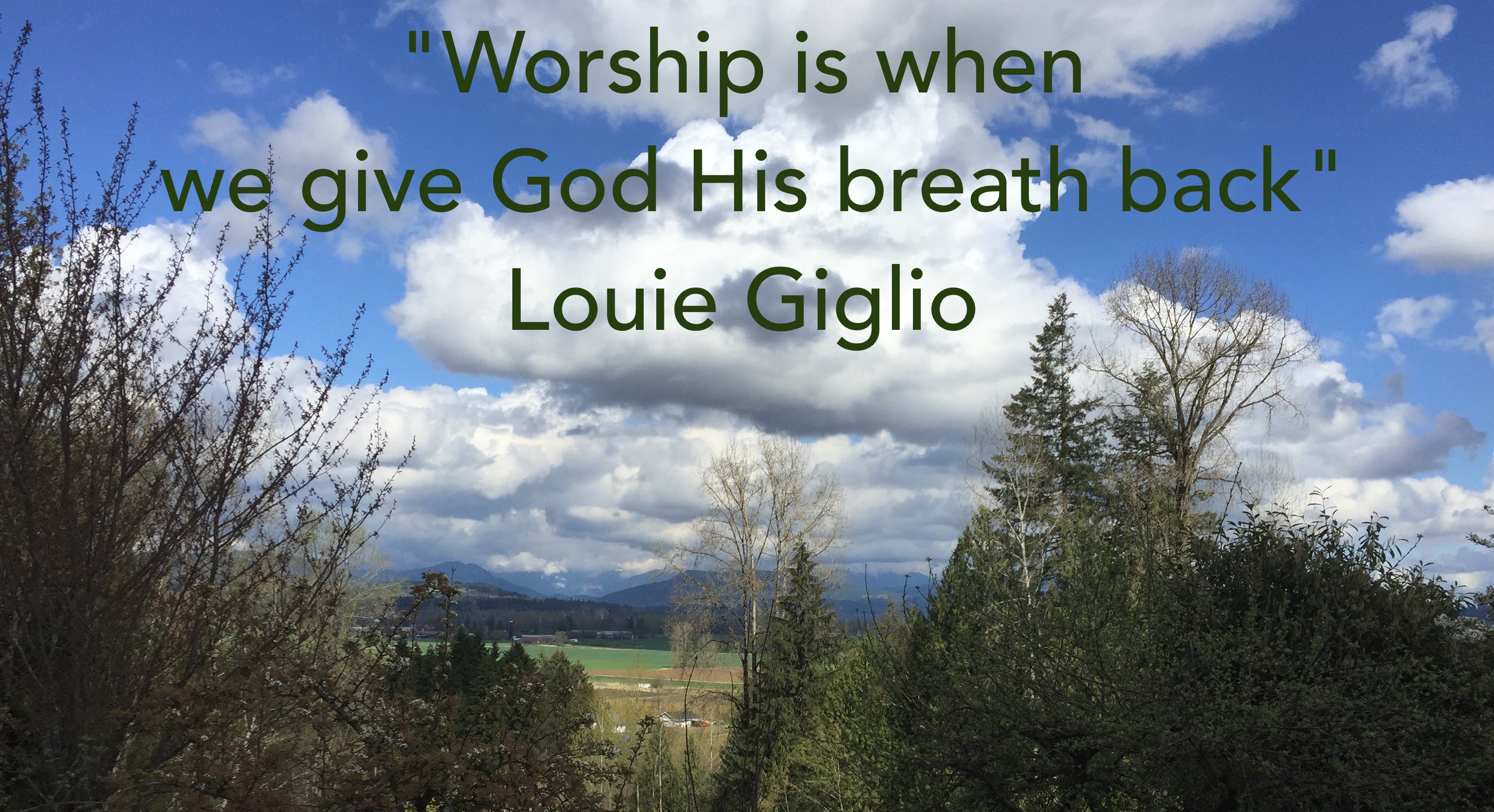
Here’s the thing (and isn’t it always the thing?), whether it is our financial giving or singing in worship, it is never about us, me, my.

Our giving,
in worship
is not our offering,
but our returning to God
what he has given to us.

When we give financially, we are returning to God a portion of what he has given to us. When we give in song, we are returning to God a portion of our breath, our humility. In both cases, he has given us what we need, as an investment in our lives. We, in turn take his investment and multiply it, returning the dividends to him …

not because he needs it,
but because
we need to give it.

“The Savior has rescued us that we might sing the song of the redeemed. May we sing it well. May we sing it constantly. May we sing it passionately. May we sing it for his glory and the advancing of his gospel until the time comes when our songs will never end.” Bob Kauflin

“Let everything (everyone) that has breath
praise the Lord!
Praise the Lord!”

Psalm 150:6

Read Full Post »

Sitting in a coffee shop recently a song came on and my fingers froze on the keyboard, my eyes lifted up from my screen and I could feel that uncontrollable smile form across my face. It was the song Unforgettable by Nat King Cole.

Unforgettable
That’s what you are,
Unforgettable
Tho’ near or far.

Like a song of love that clings to me …

I had a similar experience sitting in a church sanctuary, awaiting the start of a memorial. As I was reading the life story of the deceased, the pianist played Your Song, by Elton John and my attention was fully and completely on the words that were going through my head.

Oh I know it’s not much but it’s the best I can do 
My gift is my song 
And this one’s for you

And you can tell everybody this is your song 
It may be quite simple but now that it’s done 
I hope you don’t mind 
That I put down in words 
How wonderful life is while you’re in the world

What is it that causes a song to so reach into our being that we stop what we are doing and thinking, just to hear it more clearly … even though we know it so very well?

Within all humans is a natural beat, which we all walk to, within the confines of our chest and it courses throughout our bodies, from head to toes. Our heartbeat has a rhythm of it’s own and we are moved when we hear our own heartbeat in the heartbeat of another’s song. That reminder that another feels as we do, that we are not alone.

That is what I think Psalm 139 is all about. Here are a few of the first verses:”

“You have searched me, Lord,
    and you know me.
You know when I sit and when I rise;
    you perceive my thoughts from afar.
You discern my going out and my lying down;
    you are familiar with all my ways.
Before a word is on my tongue
    you, Lord, know it completely”

In this an intimate knowledge of the psalmist, by his Creator, is acknowledged. In this is not only the intimacy of the Creator acknowledged, but also declared … as though the psalmist had made a conscious realization that he is not alone … as though one day the lightbulb came on, and the psalmist was stopped in an instant when he heard his own heartbeat … in the heartbeat of God.

Our father sings the song of our heartbeat,

telling us that we are never alone.

Read Full Post »

Anniversaries of events are wonderful for providing reflection, perspective and thanksgiving.

As I write these words I am reflecting on the events of one year ago. A day that dawned early for us, as I still had a bit of last minute packing to do before the movers were to arrive. That day was full of reflection, perspective and thanksgiving as well, as we packed up a home, a life of fifteen years.

Now, looking back at the day and all the days since, I am full of thanksgiving, for though there were hard days, lonely days, even dark days, never were we left alone without hope.

This remembering brings to mind Joshua 4. This is the story of the Israelites crossing the Jordan, which had parted for them to cross, when the ark was carried across.

I love this story, as it is the completion of the trek to the Promised Land. Though there were two leaders, directing the way (God’s way), both leaders were given a route that required them to go through deep water … the Red Sea for Moses and the Jordan for Joshua.

Moses, as he was dying, told Joshua (in Deuteronomy 31:6) :

“Be strong and courageous. Do not be afraid or terrified because of them (those who may stand in their way), for the Lord your God goes with you; he will never leave you nor forsake you.”

This is the same message that Joshua was given from God himself, after Moses’ death (three times in one message from God (Joshua 1:6, 7, 9) :

“Be strong and (very) courageous”

Then, after Joshua took his place as leader, after he spoke to the people and shared the plan, they responded, in affirmation of his leadership, ending with those familiar words (Joshua 1:18) :

“Only be strong and courageous!”

He was their leader … Moses knew it, they knew it, Joshua knew it, God knew it … but this message was was not just theory, not just something to frame and place on the wall. This message was to be the mantra of Joshua, of the Israelites … of us.

Where the rubber hit the road is in the application of the message, for we cannot prove the meaning of strength and courage just when we are on our knees … we have to hold onto the meaning of this message when we are in deep water.

Soon, as Joshua and his followers were approaching the flooded Jordan, they were given opportunity to prove their allegiance to the God of Moses and Joshua … to their God.

As those carrying the Ark entered into the water, it parted, just as the Red Sea. When the Ark had reached the middle point … when they were truly in the deepest place, Joshua gave the Lord’s instruction … to have one from each tribe pick up a stone from the middle of the Jordan.

Once they had crossed the river. Once those carrying the Ark came up from the Jordan, the waters returned to where they had been. Joshua had them lay their stones together, then he piled them … and there was a good reason for this.

The Lord had a reason for instructing Joshua to have them brought out of the river and then piled on the the other side :

“In the future when your descendants ask their parents, ‘What do these stones mean?’ tell them, ‘Israel crossed the Jordan on dry ground.’ For the Lord your God dried up the Jordan before you until you had crossed over. The Lord your God did to the Jordan what he had done to the Red Sea when he dried it up before us until we had crossed over. He did this so that all the peoples of the earth might know that the hand of the Lord is powerful and so that you might always fear the Lord your God.” (Joshua 4:21-24)

These rocks/stones were part of the story of going through the place of deep waters, that their descendants would know and fear their God. But also that they would know that the strength and power of God were available to them, and to us, if we would be strong and courageous … not in our own power, but in the power of God.

These stones provide reflection, perspective and thanksgiving for a God who parts the waters.

Read Full Post »

While I was scrolling through Instagram images, months ago, I stopped to read what is written, above, and I knew, I knew it was planted there for me, for that very day, that very moment.

When I read it, I wasn’t interpreting it as some sort of prosperity gospel. No, I was reading it as a message from my loving God, who knew I needed the equivalent of someone placing their finger under my chin, lifting my face and saying it’s gonna be okay.

It’s gonna be okay …
That’s the message of the Gospel

There is a saying in this time which says, “there are better things ahead than any we leave behind.”

It is often attributed to C. S. Lewis, and he did say it, but what he was saying was in reference to what is to come once we walk through the shadow of the valley of death. In essence, Lewis was saying,

the best is yet to come

… maybe not in this life on planet Earth, but for eternity with our Saviour.

In our world, our society, our lives today, there is little emphasis on heaven. Perhaps it is a pendulum shift away from the messages of the past that were always focused on eternity. Today we look to the words of Jesus in the Gospels, “the kingdom of God is at hand” and we sometimes interpret that to mean that this very life is the goal, the kingdom … yet, what he was saying was hello, look at me, I am the kingdom of God, I am the goal.

and it is a goal that we, who have submitted to his leadership, share in.

Yet, the gospels also remind us that our current lives are not the be all, end all:

“My Father’s house has many rooms; if that were not so, would I have told you that I am going there to prepare a place for you? And if I go and prepare a place for you, I will come back and take you to be with me that you also may be where I am.” John 14:2-3

“Rejoice and be glad, because great is your reward in heaven.” Matthew 5:12

“great is your reward in heaven.” Luke 6:23

Trust God.

Trust your whole entire life to him.

He IS in control.

It will get better!

“The happy ending that God has coming is going to ROCK. YOUR. WORLD!”

“O soul are you weary and troubled?
No light in the darkness you see?
There’s light for a look at the Savior
And life more abundant and free
Turn you eyes upon Jesus
Look full in His wonderful face
And the things of earth will grow strangely dim
In the light of His glory and grace
Through death into life everlasting
He passed, and we follow Him there
Over us sin no more hath dominion
For more than conquerors we are”

Helen H. Lemmel

Read Full Post »

June has traditionally been the month of weddings. The weather is warmer, but not hot. The days are longer. Outdoor photographs are more beautiful with gardens at their peek of beauty.

We got to attend a wedding a few weeks ago and I found myself feeling rather broody.

Just days before hubby had received a letter informing him that he is no longer licensed in our home province to officiate weddings. Though that letter’s communication was the equivalent of water off a duck’s back, for hubby, it initiated an unexpected mourning for me.

I could unashamedly brag about the way he conducted weddings over the years.

He would take the position of intermediary, between the bride and groom and … anyone who could make the event stressful, in the most gracious yet firm manner.

The message that he would share would be one that was agonizingly prepared to represent the couple, from what he knew of them and what he had learned through the premarital sessions.

Then there was the ceremony, personalized as the couple chose, for he was committed that it would reflect them.

My personal favorite part of the weddings that he officiated were how he made the pronouncement … “by the power given me by the province of —-, but, more importantly, by God the Father, Son and Holy Spirit, I pronounce you husband and wife.” It just always made me smile.

So I sat at the wedding, just a few days ago, missing his ceremony, what he did so well, each part conscientiously planned and executed, always bringing the message back to the original installation of marriage.

As I got home from that wedding I got to thinking about how, in the Bible, marriage is used as a parable for Christ (the bridegroom) and the Church (the bride). As husband and wife become one, so too the Church and Christ become one … this is the “mystery” spoken of in Ephasians 5:32.

When a couple marry, their unifying is actually a re-unifying, since woman came from man’s body. Adam, meaning earth, and Eve, meaning life … woman literally puts life into the man, from whom she came. For woman to have life, she was taken from man, marriage is the redeeming of that physical separation at Creation, and the two, once again, become one.

The work of Christ’s sacrifice on the cross, to the grave and resurrection is also a redeeming of relationship. From the very beginning God intended that we, his church, would be one with him … and then sin happened. Christ, through his sacrifice, brought the church back to him … and the two, once again, become one.

As I pondered this metaphor I realized that though I was feeling sorrowful for this end to hubby being such an amazingly talented part of the union of souls, this story goes on. In the hands of God himself, who officiates the most spectacular of marriages of souls, back to himself.

“There is neither Jew nor Greek,
there is neither slave nor free, 
there is no male and female,
for you are all one in Christ Jesus.”

Galatians 3:28

Read Full Post »

« Newer Posts - Older Posts »

Lessons from a Lab

From My Daily Walk with the Lord and My Labrador

From The Darkness Into The Light

love, christ, God, devotionals ,bible studies ,blog, blogging, salvation family,vacations places pictures marriage, , daily devotional, christian fellowship Holy Spirit Evangelists

Karla Sullivan

Progressive old soul wordsmith

Becoming the Oil and the Wine

Becoming the oil and wine in today's society

I love the Psalms

Connecting daily with God through the Psalms

Memoir of Me

Out of the abundance of my heart ,I write❤️

My Pastoral Ponderings

Pondering my way through God's beloved world

itsawonderfilledlife

FIXING MY EYES on wonder in everyday life

Perfectly Imperfect Life

Jesus lovin', latte drinking, dog lovin', Kansas mama and wife.

What Are You Thinking?

I won't promise that they are deep thoughts, but they are mine. And they tend to be about theology.

Sealed in Christ

An Outreach of Sixth Seal Ministries

Amazing Tangled Grace

A blog about my spiritual journey in the Lord Jesus Christ.

Following the Son

One man's spiritual journey

Fortnite Fatherhood

A father's digital age journey with his family and his faith

Forty Something Life As We Know It

I am just an ordinary small-town woman in her forties enjoying the country life. Constantly searching for wisdom on a daily basis.