Feeds:
Posts
Comments

Archive for the ‘life’ Category

It’s when I see a leaf fall, flowers fade, the sunset after dinner, feel the chill in the morning air. Autumn is here in more ways than just the change of calendar … and I feel sad.

Autumn was once my favorite season, with it’s red leaves, sweater weather and talk of Thanksgiving. It is the season hubby and I met and were married, the season when two of our three were born. It was my favorite season …

Then, for some reason, unknown to me, I began to see it, not as the start of something new, but the end of something loved.

Don’t get me wrong, I do still take delight in the cool breeze and changes in the color of the leaves, but … the seasonal change … it also seems to herald endings.

The older I get the more I embrace the heat of summer, daylight stretching into the night, bare feet, leisure time.

I recently read a verse that made me ponder these feelings about the autumn.

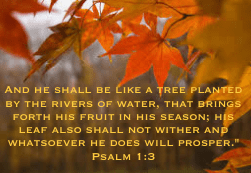
“And he shall be like a tree planted by the rivers of water, that brings forth his fruit in his season; his leaf also shall not wither and whatever he does will prosper.” Psalm 1:3

Maybe that is it … maybe it’s the withering that is partially to blame for my apathy towards this once favorite seasonal change. Maybe I am starting to see myself as withering and fruitless.

It is so easy to feel less fruitful once the house is quiet of the daily noise of kids in the house. It can feel a bit like you’re a leaf that was blown off the tree.

Yet, if my hope is in God, if I stay planted near him (in prayer and in reading of his word), this Psalm assures me that I will still produce fruit in my life, still be used by him to do his will.

A number of days ago, hubby was beckoned to an elderly lady. Originating from Southeast Asia, Canada has been her home for many years. Now into her nineties, she spends her days praying.

all. day. every. day.

This is what she says is her calling, her purpose … and she fulfills it beautifully.

When hubby walked to her, she said, “I am going to pray for your family” and immediately proceeded to do just that.

“It was just beautiful. Something so special,” he said, when he told me at home later.

This woman, though very much withered physically, has stayed near the living water and she has not withered in spirit or purpose one bit. She is still, very much, producing fruit.

Kinda makes me want to go play in the leaves.

Read Full Post »

Dumpster fire … that is what I have heard most to describe 2020, our world.

It seems like either the world is coming to an end or the journalists and reporters are so hyped up on bad news that they can deliver nothing else to us.

What is the antidote, the cure for everything that is so … 2020?

gratitude is the antidote

It may seem so simplistic, but giving thanks, being appreciative, not only are nice things to do, but they are also actions that change our brains. Odd as it may sound the more gratitude we practice in our lives, the more positive our thoughts become.

This would be the real life, there are studies with evidence behind them, working out of a biblical proverb:

“as a woman/man thinks, so is she/he”

Proverbs 23:7

In Canada this weekend we celebrate Thanksgiving. We decorate with pumpkins and colored leaves, gather with family and friends (or not … thanks Coronavirus), we roast a turkey, we wear our stretchy pants. But it is more than just a long weekend, for it is also an opportunity to be thankful in our thoughts, our actions and our words.

It’s the perfect opportunity to make eye contact with someone and say the words, “I am thankful for you,” or give someone a gift and just say, I was thinking fondly of you and wanted to show you I care, or write a letter, an email a note and just say I am thankful for you.

Just last week I had the opportunity to be on the receiving end of a gift from a stranger. When I approached the drive through window to pay for my steeped tea, the person working there said that the previous person had paid the $1.62 for my tea. I was shocked, speechless. Honestly, the way I felt was as if the cost paid was much, much more. I think it was because it was unexpected, undeserved. All I could do was feel the gratitude.

I just wish I had thought to pay it forward, covering the cost of the next person’s order, to keep the gratitude flowing. But … hindsight is 20/20.

As gratitude realigns our mind to focus on the positive, I hope that we might be able to respond to the negatives of 2020 with gratitude, offering thanks for who and what we have in our lives, rather than adding more fuel to the dumpster fire that is currently burning up the good in our minds, our world.

Happy thanksgiving to you, reader. I want you to know that, though I may not know you, I am thankful that you have taken the time to read my ramblings as I wander and wonder.

Read Full Post »

It seems every time I turn on the radio I encounter talk of leadership, or, more specifically, political leaders and wannabees.

There is an election that has been called in our province for later this month, but the news is at least as much about the election south of us, in November (somehow, our media outlets and population have become convinced that US politics need more airtime than our own).

Last week I had simply had enough and stopped listening and reading.

I wish politicians would just speak their plans along with explanations of how they plan to carry them out. Tell us what they did and did not accomplish since the last election. I wish they would apologize for their errors, owning not just the victories, but their failures as well. I wish they would stop pointing fingers and hurling insults and just keep the main things the main things.

The Bible is a good place to go when I need to be reminded of the main things, but even we, who are followers of Christ, can miss the main things.

The best example of this is Israel’s waiting and hope for the Messiah.

When Jesus came, as God’s chosen Messiah, his message did not sound like what they had expected.

They wanted affirmation of the law. Thought that their safety and security was found there.

When he broke the law by healing on the Sabbath, he responded with “the Sabbath was made for humans, not humans for the Sabbath” (Mark 2:27)

The law is like a whip, beckoning strict obedience. Jesus, as the Messiah, was and is asking something more, something better. His final message to his beloved disciples has nothing to do with law, everything to do with love.

“A new command I give you: Love one another. As I have loved you, so you must love one another. By this everyone will know that you are my disciples, if you love one another.”

John 13:34-35

It is with love for our God, love for each other that redemption comes to a people, a world in need of saving. It is through love for others that communities strengthen. It is only love, only the leadership of Jesus that will bring (eternal) health and growth to a nation.

He never had to point fingers at the opponent, for what he has to offer is so good that no other is even worthy of mention.

What he has to offer is love … and it’s a promise that will has been, is and will be kept.

Read Full Post »

Harrison Lake

There we were, sitting in a boat in the middle of a lake, “this lake is about 60km long and over 900 feet deep (gotta love the normalcy of Canadian mixing and matching of metric and imperial systems in one sentence).”

That’s a big lake.

And. I. felt. so. small.

and it felt so good.

It was like a correction, a righting of a wrong. For, in the vastness of our physical world, I am indeed small … insignificant.

When I look at the night sky and see the work of your fingers—

    the moon and the stars you set in place—

what are mere mortals that you should think about them,

    human beings that you should care for them?

Psalm 8:3-4

I do not just not size up in my physical world, but also in the spiritual world as well. My God is so big (and all of us who grew up going to Sunday School are singing the words, “so strong and so mighty, there’s nothing my God can not do”). I am so small.

It is good to be reminded of the space I occupy versus the space available. The relative insignificance of me … the great significance of the creator of this world, of me.

Then to remember that he, who is great, sacrificed his best for me. So that I would be his, eternally his. Not because of something I … who am so small … accomplished, but because of what Christ accomplished on my behalf.

O Lord my God,
When I in awesome wonder
Consider all
The works Thy Hand hath made …

Then sings my soul,
My Savior God, to Thee,
How great Thou art!

Read Full Post »

We’ve all heard them, maybe even spoken of ourselves (as the child or the parent). Idioms that communicate that a child is so very similar in looks, behavior or attitude.

“Well doesn’t she just take right after you”

“That apple didn’t fall far from the tree”

“He’s a chip off the old block”

Genetics are an amazing thing. Yet, there is also the question of nature or nurture?

As a Christian, we might even look to the negative attitudes, habits and behaviors as generational curses … leaving us a little less personally ‘guilty’ for the nasties that we bring to life.

Yet, in Ezekiel 18 we are reminded”

“The child will not be punished for the parent’s sins, and the parent will not be punished for the child’s sins. Righteous people will be rewarded for their own righteous behavior, and wicked people will be punished for their own wickedness.” (v. 20).

In this account we are reminded that God does not see us through our families, he sees us, our choices, our actions and attitudes as individuals who are free and responsible to make our own choices … even when we have been nurtured a certain way.

If we grow up in a home where physical abuse happened, it is our responsibility to not continue inflicting pain on others (seek counselling).

If we grow up in a home where we saw substance abuse, we must do whatever we can to avoid that substance (join a 12-step program for loved ones of substance abuse users/addicts).

If we grow up in a home where passive aggressive behavior was the norm, choose to live differently (learn to be assertive (not aggressive), to speak what is on your mind, stop reading into the motivations of others).

As I read back, those suggestions might sound far easier, far more simplistic than the reality is for those living in tough situations, with not the best role models.

Then there is the parent or grandparent who inflicted the pain … is there any hope for them?

Ann Voskamp tells a story that kind of stopped me in my tracks:

“I knew a guy who said: “Dad – I need you to say that I’m enough …”

Sometimes what you want most is your father/mother) to give you the greatest gift: For them to believe in you.

But his father turned to him and said – I can’t. Because my own father never said it to me.”

What your father (mother) never gave you, may be because it was something he/she never had.

This can be an unspoken bond with the one who has wounded you? You both carry the same wounds.

You can’t deeply love your parents – until you grieve the deep wounds of their life.

Even now, we could be the ones to say what every parents long to hear: “I love you and nothing you’ve ever done or ever failed to do will change how I forever love you.

I’m not ashamed of you but I acclaim you, for the battles that count as wins because you kept getting up again.”

https://annvoskamp.com/2020/06/what-all-our-hurting-hearts-need-most-this-fathers-day/

In this world where we encourage the elimination of toxic people from our lives, we forget that our scars can be the ointment that heals others … and that can be the miracle cure for our own. For our scars may, indeed, be very similar … originating from a common source.

We need to remember that God does not look at us through the sins of generations before us, he sees us for who we are as his child. It is how we choose to live that we are responsible for. And it is his favor, his grace that moves us beyond our nature and our nurture.

Fight the tendency to follow in your father’s or mother’s dirty footprints. Live differently! But also keep the door open to finding a new family path, by being the one who nurtures healing.

Read Full Post »

Read Full Post »

Unknown Artist – Germany 1560s

I realized the problem … me.

It is something that had been gnawing at my for quite awhile. I couldn’t figure out why my advise wasn’t being taken … I mean, I do know things.

It wasn’t like this was the first of our three adult kids to ignore my sage advise, my words of wisdom. But … this time is was really contributing to my knickers being tied up in a knot.

Then it hit me … I am the problem …

It was a simple thing, a parental ‘letting go’ of control of an area of one of our kid’s lives. An appointment had to be made, so I said, here’s the number you need to call and make an appointment asap.

An hour later … call not made.

The next morning … call not made.

That afternoon … call still not made.

Three days late … notta!

The procrastination to make this simple appointment was getting under my skin.

“But, it’s not rocket science.”

“How hard is this?”

“It will take mere minutes.”

… all my thoughts in response to this … nothing.

Then it hit me … when I was that age, I hated to make telephone calls to doctors, dentists, hairstylists, businesses. I would avoid it at all costs. Actually, I still hate doing it … I don’t have good rationale for my avoidance, it’s just an area that I can procrastinate with natural flair. Except that, I have mostly overcome it, managed to accomplish such tasks with little procrastination.

So, I started to look at other areas of our (adult) kid’s lives that made me kinda crazy. The things that had me shaking my head most often were the areas that, at a younger stage of my own life, I struggled with. Whether it was getting enough sleep, spending/saving money, time management, or … making an appointment, it is the things I struggled with that I am less gracious or understanding about in my kid’s lives.

This realization had me thinking about the parable of the unforgiving debtor/servant (Matthew 18:21-35). A man had a debt he simply could not repay the king, so he begged for mercy … for time to repay it. The king not only let him go, but forgave his debt. The man then went, straight away, to find one who owed him money and he demanded it immediately. This indebted man also begged for mercy, for time, but he was thrown in jail. When the king heard this story he was aghast. So he had this man thrown into prison (after a good tongue lashing).

The Matthew Henry Commentary on this parable states:

“Though we live wholly on mercy and forgiveness, we are backward to forgive the offences of our brethren.”

Though this story deals with debts, which my own story does not, it also deals with learning about grace and mercy.

In my life, I have had to learn from my own successes and (maybe more-so) mistakes. I have had to pay the price (literally) for debts unpaid, for late nights, for poor time management, for not making an appointment. These experiences have helped me to learn and grow.

But, I cannot expect my kids, who are still in the early stages of learning and growing, to have mastered the same level of learning as I. They too need to learn from their experiences and that means making their own mistakes along the way as well.

They, like me, will learn best from their own successes and errors. I hope that I can view their struggles … the ones I have learned from … with eyes of grace and mercy.

Read Full Post »

I love mysteries. British crime dramas are my favorite shows to watch, for I love to see how the brief references to people, items or activities at the beginning give hints to where the mystery will travel.

When I read the Bible, I do so with a similar mystery-hunter mindset. I am constantly trying to pay attention to the broad strokes as well as the tiniest of details … for, I believe, if it is important to God that it be included in the narrative, then it must have significance to me today.

This summer I have been considering the trials of the Prophet Job, but I have been obsessed with his dung heap.

There he is, just outside the village gates (presumably down wind), sitting on a pile of … crap, scraping the crusts off the painful sores that cover his body. It is not just his body that aches, for he has lost his livestock, his servants and all of his children … the heap of dung is a representation of his life in this part of his story.

So … why was it so important that we know that Job is sitting on a dung heap?

I think part of it is time and setting. This dung heap would be like the village dump for … feces. It would be brought just outside the town and burned, providing a way to eliminate smell and bacteria from the living areas of the community.

but, I think there might be another reason why it was mentioned … and this might be where there is application for us today.

It is here, on the dung heap, that Job mourns his losses, where he scraped his sores with pottery, where he received three friends, where he replied to his wife’s encouragement to “curse God and die” with, “shall we accept good from God, and not trouble?”

I find it interesting that Job, a wise man, a Prophet, a righteous man, is sitting on a dung heap … in emotional and physical pain, front and center for all to see his response to pain.

So, what does this communicate to us, today?

I think that there is something important that we can learn from Job on his dung heap:

it is okay
to sit on a dung heap

In Job’s story, he literally sat on a dung heap, where he mourned, wept … where he wallowed in his sorrows for a time. It is one of the most real, authentic examples in the Bible of acknowledging how one feels when in the depths of despair. In this Job shows us that even a godly and righteous man can have time wallowing in self-pity.

In our society and maybe especially in our Christian circles, we do not look at a metaphorical sitting on a dung heap as an example of how a person should live. We encourage moving on, taking the high road, pulling ourselves up by our boot straps. In other words, we emphasize outward recovery, before allowing the bleeding to stop first.

Yet, there is a purpose in tears, in mourning and even in self pity.

Did you know that when humans cry for emotional reasons our tears are not just composed of water and salt, but also hormones and toxins that have accumulated due to emotional stress. When we cry, we are ridding our bodies of these, while at the same time the process of crying stimulates our bodies to produce endorphins … the Dr. Feel Good of hormones.

 After studying the composition of tears, Dr. Frey found that emotional tears shed these hormones and other toxins that accumulate during stress. Additional studies also suggest that crying stimulates the production of endorphins, our body’s natural pain killer and “feel-good” hormones.” Interestingly, humans are the only creatures known to shed emotional tears, though it’s possible that elephants and gorillas do, too. Other mammals and also salt-water crocodiles produce reflex tears that are protective and lubricating.

Grieving is the process towards acceptance of broken attachments. We must go through the grief (not around it) to reach that acceptance and then to learn how to live without those we had attachments with.

Self pity can be a most beneficial act of self care. It can also be the most authentic way to healing. It is healthier to move through emotions than to jump over the less appealing ones. The pain is there, whether you ignore it or walk through it, but if you ignore it, it will remain … unnamed, unhealed, like a full suitcase that has never been unpacked. Name the authentic emotion you are feeling and feel it fully.

Job felt his pain. He wallowed in it, agonized over it.

And, once through it, God reminded him who Job was, who God is … It was then that Job was ready to move off the dung pile.

So, if you are sad, have lost something or someone near to you, if life has not turned out as you hoped … sit awhile on the dung heap. Shed the tears you’ve been bottling up. Weep for yourself awhile.

Then, turn your face to God and have him remind you who you are, in him.

Just … don’t rush.

Read Full Post »
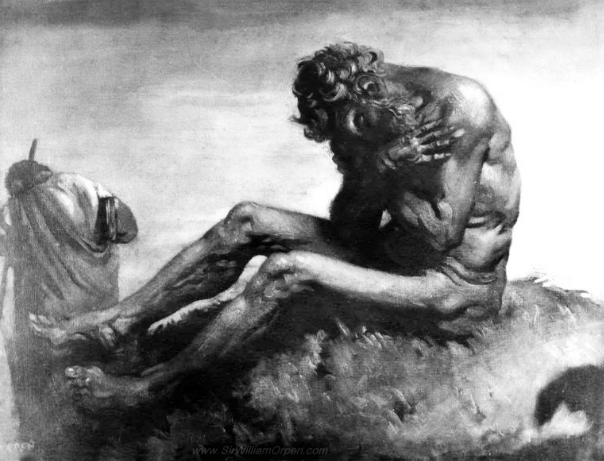
“Job” (the first Job painting)
by William Orpen

… the patience of Job

an idiom birthed in the strength of an Old Testament prophet who refused to curse God and die.

I have been pondering Job over the past few months … pondering his time of sitting on the dung heap.

The image (above) of Job on his dung heap, naked and (with the image of a man walking away) alone spoke loudest to me of all the paintings of him by all the greatest painters. Painted by Irish painter William Orpen before or around 1900. Later he was dispatched as an artist to the Western Front in WW1. His paintings (and poem) inspired from his visit to the site of the Battle of Somme resonated with me as I looked a this image of the prophet Job, alone after the ravages of the war he was forced to fight.

Why was Job sitting on a dung heap?

Actually, some versions say he was sitting on ashes, not a dung heap. From my research it was both. The solid waste of animals would be taken to a select spot just outside the village, where it would … bake in the sun and eventually would be burnt (no doubt to eliminate smell as well as bacteria). It is there, on this ashy dung heap, where those who were undesirable outcasts (economically, socially or physical conditions) would sit and beg.

It would seem that Job had lost just about everything in his life … his livestock, servants, children and his health. His body was covered with sores. His only relief was scraping his sores (releasing the painful pressure, perhaps) with a broken piece of clay. His wife had told him to curse God and die. His friends inquired of what sin he had committed.

Job’s is the story that, perhaps, provides the theme of the children’s story “Alexander and the Terrible, Horrible, No Good, Very Bad Day”.

Job’s is the story that, perhaps, provides the theme of some of the seasons in the lives of us all.

More on what the dung heap teaches us next time.

In the meantime, click here and read Job 1-3 … it’ll just take a few minutes (and that’s coming from one who reads so slowly). This will help to prepare us for the dung heap.

Read Full Post »

You read that title right … there are good things that have come from this Covid 19 pandemic.

Call me Pollyanna if you wish, but my mind seeks to see the good in the bad as it’s method of processing, accepting and moving on from the dark and nasties of life.

The thing is, as I went back to work last week and prepare for the start of a new school year in the week to come, it hit me that there are at least three good things that have come from the Covid 19 pandemic.

The first is hand washing. Not only are we washing our hands, but there are reminders everywhere of how and how long, ensuring that we are not just dipping our hands in water and then drying them. This simple and quick act of protection will probably also help to reduce the spread of viruses beyond Covid 19. According to the CDC, hand-washing alone can reduce respiratory infections by 16% and this practise can reduce the spread of other diseases as well.

The second is that people will not just be encouraged, but will be expected to stay home when sick if one is feeling unwell. Working in a high school I have had the experience of what we call ‘typical’ students cough or sneeze directly towards my face … yikes! Yet, I have also had the experience of working alongside colleagues who have decided to work while sick, spreading their viral germs through the air and on every surface from the photocopier to the door handles. I have to say I actually feel more confident returning to school, with this new social, school and workplace change in thinking to feeling unwell.

The third is the bubble. In North America (and all around the world), we were encouraged to stay home, within our household bubble. Our families were forced to spend time together. Now, Pollyanna-like I may be, I do recognize that this was not a good or safe reality for some, where households are the most dangerous and harmful places to be. But, for the majority, we were involuntarily brought together, under one roof. During this time people learned how to cook their dinners, how to play board games, do puzzles, watch movies, how to garden, go for daily family walks and bike rides. We learned what together means, we might even have learned who lives under our roofs.

There are many unfortunate and even tragic results of the Coronavirus, but I do hope that these three have positive changes in our thinking and in our communities, long term.

Read Full Post »

« Newer Posts - Older Posts »

Lessons from a Lab

From My Daily Walk with the Lord and My Labrador

From The Darkness Into The Light

love, christ, God, devotionals ,bible studies ,blog, blogging, salvation family,vacations places pictures marriage, , daily devotional, christian fellowship Holy Spirit Evangelists

Karla Sullivan

Progressive old soul wordsmith

Becoming the Oil and the Wine

Becoming the oil and wine in today's society

I love the Psalms

Connecting daily with God through the Psalms

Memoir of Me

Out of the abundance of my heart ,I write❤️

My Pastoral Ponderings

Pondering my way through God's beloved world

itsawonderfilledlife

FIXING MY EYES on wonder in everyday life

Perfectly Imperfect Life

Jesus lovin', latte drinking, dog lovin', Kansas mama and wife.

What Are You Thinking?

I won't promise that they are deep thoughts, but they are mine. And they tend to be about theology.

Sealed in Christ

An Outreach of Sixth Seal Ministries

Amazing Tangled Grace

A blog about my spiritual journey in the Lord Jesus Christ.

Following the Son

One man's spiritual journey

Fortnite Fatherhood

A father's digital age journey with his family and his faith

Forty Something Life As We Know It

I am just an ordinary small-town woman in her forties enjoying the country life. Constantly searching for wisdom on a daily basis.