Feeds:
Posts
Comments

Archive for the ‘Faith’ Category

IMG_3212

“Christ is risen
He is risen indeed”

The traditional greeting of Christians on Easter Sunday. It is called the “Paschal greeting” and was used in Orthodox and Catholic early churches. Sometimes it is accompanied by three kisses, on alternate cheeks.

It is said to have come from the gospel of Luke (v. 34):

“It is true!
The Lord has risen and has appeared to Simon.”

This said after two disciples met a stranger on the road, as they walked to a village called Emmaus. This stranger, who appeared to know nothing of the events of the days prior, when Jesus, the prophet, was crucified.


You see, the stranger was Jesus himselfbut they were kept from recognizing him” (v. 16).

The stranger was told, but we had hoped that he was the one who was going to redeem Israel. And what is more, it is the third day since all this took place. In addition, some of our women amazed us. They went to the tomb early this morning but didn’t find his body. They came and told us that they had seen a vision of angels, who said he was alive. Then some of our companions went to the tomb and found it just as the women had said, but they did not see Jesus” (v. 21-24).

They seemed to think that, because of Jesus’ death, maybe Jesus hadn’t been the redeemer/saviour that had hoped him to be, and because they did not see Jesus, who was supposedly alive, they had missed out. All this blind disappointment, in the man walking by their sides.

Then this stranger rebukes them, “How foolish you are, and how slow to believe all that the prophets have spoken! Did not the Messiah have to suffer these things and then enter his glory?” And beginning with Moses and all the Prophets, he explained to them what was said in all the Scriptures concerning himself.” (v. 25-27).

So this stranger (aka Jesus himself), slaps them upside of the head with what he always uses … what the prophets said. He reminds them that, according to the prophets, their long-awaited saviour had to suffer, had to die.

Then came the fork in the road, Jesus continuing on, but the disciples stopping in Emmaus for the night.

The disciples “urged him strongly, “Stay with us, for it is nearly evening; the day is almost over.”” (v. 29). So Jesus joined them for dinner. 

It was there, at the table that the lightbulb came on for the pair.

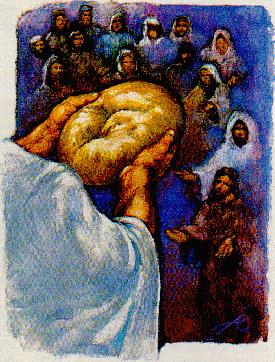
“When he was at the table with them, he took bread, gave thanks, broke it and began to give it to them. Then their eyes were opened and they recognized him” (v. 30-31).

“He took the bread,
gave thanks,
broke it
and began to give it to them”

Let’s rephrase that:

He sat before them,
gave thanks for the broken bread,

his body, days before, broken,
for them

It was in the reminder of Jesus’ broken body, for their broken lives, that their eyes were opened to who is was … for them. It is today, Easter Sunday, that we are all reminded that his body was broken, for our broken lives … but are our eyes opened to this, our Saviour?

” … and he disappeared from their sight” (v. 32). A bit anticlimactic … Just when he is known to them, he leaves them … again.

“They asked each other, “Were not our hearts burning within us while he talked with us on the road and opened the Scriptures to us?”” (v. 32). Not so anticlimactic after all, for now that their eyes were fully opened, they realized that something in them had been stirring as they walked and talked with him on that road, to Emmaus. Something in them knew they were in the presence of their Saviour, but, as with all of us, they were blind to his presence.

“They got up and returned at once to Jerusalem. There they found the Eleven and those with them, assembled together and saying, “It is true! The Lord has risen and has appeared to Simon” (v. 34-35).

It is true! … almost as if they were saying, Indeed, the Lord has risen!
Read Full Post »

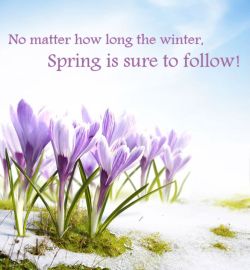
Screen Shot 2018-02-18 at 9.07.24 PMAs I reflected on the tough season a friend is currently going through, I was amazed … because, in spite of how tough things were, she was  looking at the tough things with thankfulness, hope and a faith that it would all work out.
Me of littler faith …

I kept considering her positivity, that was beyond just posturing, it was purposeful positioning of her thoughts. In a sense it was purposeful, planned prophesying. She choose to believe that the future, no matter what direction it went, was controlled by her creator, who cared far more about her eternal heart than her physical position … and he would work it all out …

simply because,

she knows that she is loved.

Amen.

IMG_2894

Read Full Post »

194510_10150155497290789_6484144_oHappy belated International Women’s Day.
I admit, I only knew that because the Google search bar told me. When I read that it was, sarcasm and cynicism crept into my mind.

“If we need an International day to celebrate it, to make us ‘special’, then we haven’t accepted equality in our own hearts, minds and souls.” (me)

Don’t get me wrong, I do believe that both genders are equal, should be paid equally for equal work, should be treated equally in society, should have opportunities equally, should be valued equally in terms of rights, in terms of value.

I just struggle when any group of individuals wants to be the headline of the day. Even if it is a group I belong to.

I believe that equality was modelled for us by Jesus himself (John 8:1-11), when a woman caught in the act of adultery (presumably with a man … but he wasn’t brought to Jesus).

The Pharisees, who brought her to him, said, “hey Jesus” (I hear baiting in their voices). Then they proceed  to remind Jesus that the Law of Moses (their law, his Law) says that such ‘persons’ should be stoned, and ask him what he says (they were trying to incriminate him in disobeying the Law).

Then Jesus goes all … silent, and writes in the sand … (AND NO ONE THOUGHT TO TAKE NOTE OF WHAT HE WROTE!) He stood up and said, “whoever here has never sinned, take the first shot at her.”

And they scatter, like all of them.

So, it’s just the woman caught in adultery and Jesus left.

He says to her, “where are they? Is there no one ready to throw stones at you?”

And she says, “no one, Master” (you could say this was her conversion experience).


So Jesus (probably shrugging) says, “neither do I. Go on your way.” (ahh, love it). 

Now the modern version might end there, but the story is incomplete with what he said after that …

 ” From now on, don’t sin.”

He didn’t patronize her with “poor you” talk. He didn’t bring up her tough upbringing, or difficult economic situation. What he did do was he called a spade a spade, to the ill-intended religious leaders, and to the woman before him. He treated them equally.

Actually, he didn’t. What Jesus did for this woman was more. He gave her a new and improved trajectory for her life. He led her to acknowledge that she had to accept responsibility for her own actions (something he didn’t bother doing with the son of a guns who used her … in more ways than one).

What Jesus did for this woman was to empower her to not be a victim of her circumstances. His attention and care for her empowered her right to freedom. He acknowledged her ability to choose a better future than her past.

To move away from the circumstances we are dealt with, to choose to live differently, to accept responsibility for the wrongs we, ourselves, have done … that is woman power!


Read Full Post »

FullSizeRender

With the passing of Billy Graham, from Earth to eternity, I keep hearing, in my mind, those familiar lyrics …

Just as I am, without one plea,
But that Thy blood was shed for me,
And that Thou bid’st me come to Thee,
O Lamb of God, I come! I come!

This hymn, written in 1835 by Charlotte Elliot, who referred to Just as I am as her spiritual autobiography. It is a song of coming to Christ, of acceptance. Really, it is a song of forfeit to some greater force, and with the greatest of humility.

My own personal connection to it was that it was used when I was baptized, at the age of sixteen. A verse was sung after each person was baptized.

I remember that day so well, and the pondering that led to my decision to be baptized. I had been told by a friend that without baptism I would not enter heaven when I died. I did not agree.

That disagreement sent me right where, I believe, God wanted me to go … to the Bible. I read every verse and book chapter, that I could find, that spoke of baptism. I learned what a commentary was, and I poured over their understanding of biblical texts on the subject.

Finally, I came to my own conclusion, that baptism was simply the outward expression to the world, of the acceptance I had made, of the redemption availed to me through Jesus. I also came to the conclusion that it was what I would choose to do, because I wanted the world to know that I was associating with Jesus, for the rest of my life. Not because I had it all together, not because I was perfect, but because I was renewed, redeemed.

And that is the appeal of the hymn, Just as I am. It is not a song about how we have it all together. As a matter of fact, it is quite the opposite:

without one plea
rid my soul of one dark blot
many a conflict, many a doubt,
Fightings and fears within, without
poor, wretched, blind

It is a song of self-realization of the lacking, the negativity, the sin in our lives. And it is in acknowledging where we lack that openness to what Christ has for us, is birthed. Even in the negatives, each verse ends with “O Lamb of God, I come!”

My favourite verse is the fifth (I believe the last in the hymnal I grew up with),

“Just as I am – Thou wilt receive,
Wilt welcome, pardon, cleanse, relieve;
Because Thy promise I believe

That is it, belief.

Not vast amounts of tithing, piety or perfection, but because I believe.

Romans 10:9 tells us, “If you declare with your mouth, “Jesus is Lord,” and believe in your heart that God raised him from the dead, you will be saved.”

Though my baptism was not some magical event, it is one of the most special events of my life, because it was the first time that I declared with my mouth that Jesus is my Lord … it was the public expression of the change in my heart.

Is Jesus your Lord? Do you believe it, in your heart, that he was raised from the dead? for you?

Believe, and be saved … just as you are.

Just as I am – without one plea,
But that Thy blood was shed for me,
And that Thou bidst me come to Thee,
-O Lamb of God, I come!

Just as I am – and waiting not
To rid my soul of one dark blot,
To Thee, whose blood can cleanse each spot,
-O Lamb of God, I come!

Just as I am – though toss’d about
With many a conflict, many a doubt,
Fightings and fears within, without,
-O Lamb of God, I come!

Just as I am – poor, wretched, blind;
Sight, riches, healing of the mind,
Yea, all I need, in Thee to find,
-O Lamb of God, I come!

Just as I am – Thou wilt receive,
Wilt welcome, pardon, cleanse, relieve;
Because Thy promise I believe,
-O Lamb of God, I come!

Just as I am – Thy love unknown
Has broken every barrier down;
Now to be Thine, yea, Thine alone,
-O Lamb of God, I come!

Just as I am – of that free love
The breadth, length, depth, and height to prove,
Here for a season, then above,
-O Lamb of God, I come

Read Full Post »

springWhat was that?

I stilled my breathing, listening beyond the thunder of the furnace.

There it was, again. It’s the sound of birds singing the dawn chorus.

I opened the window to hear more clearly.

This was the first morning I have heard it, and though it was just one bird, it’s morning return lifted my face, my heart.

I awoke with nothing, the well was empty of words of hope and life, and here it was … music to my ears, theology for my soul.

” the time of the singing [of birds] is come …”
Song of Solomon 2:12

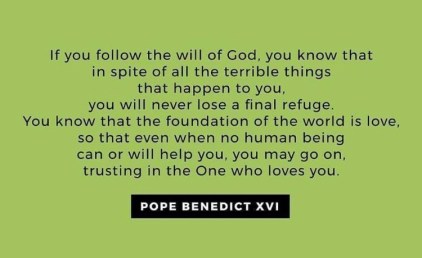
Spring is coming,

and spring always follows the winter.

The winter may be cold, and snow-filled, and dark.

Your winter may be heavy with burden, heart-ache, and despair, with little light to shine the way through.

But spring always follows the winter.

” the time of the singing [of birds] is come …”


Read Full Post »

Screen Shot 2018-02-26 at 6.13.43 PMWithin the Bible is the record of creation, the fall of humanity, the great successes and failures of people of faith, the prophesy of redemption through the Christ, the fulfillment of it in the life of Jesus, the history of the early church, and the future that awaits all of humanity when Christ returns for the grandest of grand finales.


The Bible is the source of truth, for those who choose to accept and follow the message held within it’s pages. Although my understanding of the Bible is incomplete, I believe that it is where the answers for all of life are to be found.

Recently I came across what I thought were conflicting messages, all within the same setting, spoken by Jesus himself. Then I looked more closely, and understood that I had only known what was being said, in part.

It is the Passover feast.

The disciples have been cleaned up (foot washing), fed up and soon to be split up.

Peter asked Jesus, “Lord, where are you going?”
Jesus replied, “Where I am going, you cannot follow now, but you will follow later.”
(John 13:36)

Then, in the next chapter (still around the table, in the upper room), and seemingly just moments later, Jesus says,

“Do not let your hearts be troubled. You believe in God; believe also in me. My Father’s house has many rooms; if that were not so, would I have told you that I am going there to prepare a place for you?  And if I go and prepare a place for you, I will come back and take you to be with me that you also may be where I am.” (John 14:1-3)

So … you can follow … but not now.

Jesus had to die. He had to suffer and experience separation from his Father, to complete his purpose for coming to Earth. This was something that only Jesus could do, a voyage only he could take, so he told them, you cannot follow now.

He had to go and prepare a place for them, for us. But he didn’t just leave them/us here, with no hope, for he promised to come back and take you to be with me. 

These verses have even more meaning when you read 1 Corinthians 15:50-54:

“I declare to you, brothers and sisters, that flesh and blood cannot inherit the kingdom of God, nor does the perishable inherit the imperishable. Listen, I tell you a mystery: We will not all sleep, but we will all be changed— in a flash, in the twinkling of an eye, at the last trumpet. For the trumpet will sound, the deadwill be raised imperishable, and we will be changed. For the perishable must clothe itself with the imperishable, and the mortal with immortality. When the perishable has been clothed with the imperishable, and the mortal with immortality, then the saying that is written will come true:

“Death has been swallowed up in victory.”

I will never fully understand all that Bible teaches, but it does not negate the fact that it is truth, and that it is applicable yesterday, today and tomorrow.

“Now I know in part;
then I shall know fully,
even as I am fully known.”
1 Corinthians 13:12


Read Full Post »

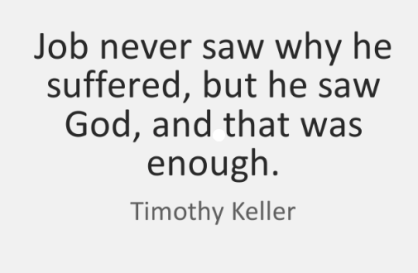
IMG_2927

“Positivity is the key to success”

The words rang through our home numerous times each day, from a daughter to her brother throughout his adolescents.

They are good words, they are encouraging words … but they are not always the words one desires to hear when negative situations seems to falling into one’s lap, over and over, day after day.

The Bible allows for a little negativity:

  • Job, quite literally, sat upon a dung heap numbering his woos
  • the Psalmist has numerous accounts of laments
  • Esau cried out loudly when his birthright was given to his brother
  • heck, an entire book in the Old Testament is called Lamentations

It is okay to to lament, sit for awhile on a dung heap and to cry out to God.

Our God knows and sees all that we experience in this life. He knows when we hurt, when we are angry, when we ache. To not share our laments with him is pointless, for we cannot hide anything from him.

With our acknowledgement of the negatives in our lives, can come some relief, for in the telling, the sharing of our hearts in the safety of communion with God, it can be like a needle prick in a balloon, allowing the tension of holding it all in to be broken.

In sharing our honest hearts with God, we release our negative situation to him, no longer being held down by it’s control.

Though positivity can be a key to success, dealing rightly with the negatives is also an important factor. Holding on to the negatives in our lives, as if they were a precious jewel, does not allow us the freedom that comes from handing them over to God.

And he is safe with our laments, for “he was despised and rejected by mankind, a man of suffering, and familiar with pain” (Isaiah 53:3).


Read Full Post »

image

Listening to a Christmas CD, I have found myself repeating a song I had listened to many times, yet had never really heard.

As Josh Groban’s voice fills my vehicle with the Latin words that shared how the poor and humble servant would be satiated by the gift from heaven, my thoughts drifted to Christmas.

Panis Angelicus,  (bread of angels or bread of heaven) was written by Thomas Aquinas in the twelve hundreds, as part of a communion-themed hymn called Sacris Solemniis.

In English, the lyrics are as follows:

Heavenly bread

That becomes the bread for all mankind;
Bread from the angelic host
That is the end of all imaginings;
Oh, miraculous thing!
This body of God will nourish
Even the poorest,
The most humble of servants.
Even the poorest,
The most humble of servants.
 
Heavenly bread
That becomes the bread for all mankind;
Bread from the angelic host
That is the end of all imaginings;
Oh, miraculous thing!
This body of God will nourish
Even the poorest,
The most humble of servants.
Even the poorest,
The most humble of servants.

Heavenly bread … like the manna, provided to the Israelites, by God himself, in the desert. The Israelites, complaining about the menu, forgetting from the bondage that they left when lead into the desert (perhaps a desert is not so dry and desolate).

Like manna from heaven, God send his Son to Earth. Like the Israelites who wandered in the desert, we too live our lives as if our existence is in a dry and desolate place. We too complain, not because we are starving, but because we want more than just sustenance, we strive to icing on the cake (our cake). We desire more, more, more, of all that does not satisfy.

We have within reach, even in our grasp, the bread of heaven, through the Christ child, yet me look beyond him to what is temporary. It is as though we look straight through him, all the while crying for more.

Perhaps we have too much.

Perhaps we need to be the most humble, the poorest of servants before we can be truly filled with this bread of heaven, this Christmas, and every day.

Our fathers ate the manna in the desert; as it is written, ‘He gave them bread from heaven to eat.’
Then Jesus said to them, “Most assuredly, I say to you, Moses did not give you the bread from heaven, but My Father gives you the true bread from heaven. For the bread of God is He who comes down from heaven and gives life to the world.”
Then they said to Him, “Lord, give us this bread always.”
 And Jesus said to them, “I am the bread of life. He who comes to Me shall never hunger, and he who believes in Me shall never thirst.”
John 6:31-35


Read Full Post »

14bc54934bd5226568e07a5601c0e066--ward-christmas-party-christmas-hacks

As the holly jolly, festive season is in full gingerbread house building swing, some are left asking,

What is the Christmas Spirit,
and how does one get it?

For the Christian it is the celebration of the birth of Christ, our Redeemer. But being a follower of Christ does not mean that we might not feel the spirit of Christmas in the season.

Recently someone stated that, despite watching numerous Christmas movies, they were not feeling the spirit of Christmas.

It got me thinking … (and I love it when something gets me thinking)

What is the Christmas Spirit,
and how does one get it?

Yes, I am a Christ-follower, yet I am not immune to to feelings of humdrum at this time of year. I sought out a favourite Christmas music CD to listen to in my vehicle (or my own private chapel, as I like to think of it), in the hopes of getting into the Christmas spirit, and it was … okay. I brought the tree out of storage, and set lights to it, and it is … pretty. I hung lit (not the Urban dictionary version of lit) boughs over my front door, and a wreath which did make me smile when I came home in the evenings, but …

the question persisted,

What is the Christmas Spirit,
and how does one get it?

When one searches the internet for such answers, the predominant discoveries do, indeed, point to the nativity, the birth of the long-anticipated Jesus. But what if one does not feel it?

I love the words of Peter Marshall:

“So we will not ‘spend’ Christmas nor ‘observe’ Christmas.
We will ‘keep’ Christmas – keep as it is…
in all the loveliness of its ancient traditions.
May we keep it in our hearts,
that we may be kept in its hope.” 

His words make me think of another festive quote:

“And the Grinch, with his Grinch-feet ice cold in the snow,
stood puzzling and puzzling, how could it be so?
It came without ribbons.
It came without tags.
It came without packages, boxes or bags.
And he puzzled and puzzled ’till his puzzler was sore.
Then the Grinch thought of something he hadn’t before.
What if Christmas, he thought, doesn’t come from a store.
What if Christmas, perhaps, means a little bit more.”

What the Grinch, and Peter Marshall know is that we cannot manufacture the Spirit of Christmas, we need to keep it. To keep it is to do. It is to practice it, to not just listen, but to sing the songs of announcement, joy and celebration. It is to, not just hang lights, but to look to the light that came to our world and lives. It is to, not just exchange gifts, but share the gift of hope that God’s gift is to we who have accepted it. It is to, not just watch the seasonal movies, but be moved to bring heaven to Earth for those who have little.

My searching for the feeling of the Spirit of Christmas, rekindled it in my own heart, for it is a feeling that comes from a knowledge and understanding that it comes, it has come, in spite of my actions or feelings. I only need to seek it, and reflect it.

“The Christmas message is that there is hope for a ruined humanity—hope of pardon, hope of peace with God, hope of glory—because at the Father’s will Jesus Christ became poor, and was born in a stable so that thirty years later He might hang on a cross. It is the most wonderful message the world has ever heard, or will hear.
…the ‘Christmas spirit’…ought to mean the reproducing in human lives of the temper of Him who for our sakes became poor at the first Christmas. And the Christmas spirit itself ought to be the mark of every Christian all year round.”
J. I. Packer (Knowing God)


Read Full Post »

Hopes not Fears

IMG_2071

Lately I have been pondering fears.

Though I have a bushel-full of my own fears, lately they have become especially apparent to me in others. Perhaps it is always easier to see fears in the lives of others than in ourselves.

It is, of course, wise to use caution as we live our lives, but it is easy for caution to also prevent us from being open to opportunities for learning and for life.

Last week I was assisting a student in his memorizing of Psalm 23. I have learned that, when students work to memorize it is good to give them ‘hints’ that are funny or shocking, for when they get stuck.

For instance, if a student is stuck before verse 5, which says, “you anoint my head with oil”, I will give them the hint, greasy hair.

The particular student I was assisting last week was struggling to get the following verses mastered:

“Even though I walk
    through the darkest valley,
I will fear no evil,
    for you are with me”

Finally I said to him, if you were in a dark valley, how might you feel? To which he responded, “scared”. Then I asked how he would feel if he knew that God was with him, to which he said, “not scared”.

Dark valleys, traveling to new places, starting a new job, going to a new school, moving to a new community, and trying new foods are just a few of the ‘dark and twisty’, fear-invoking experiences in life. But we can never forget that we do not enter into those experiences alone …  for you (God) are with me.

“The Lord is my shepherd, I lack nothing.
He makes me lie down in green pastures,
he leads me beside quiet waters,
he refreshes my soul.
He guides me along the right paths
    for his name’s sake.
Even though I walk
    through the darkest valley,
I will fear no evil,
    for you are with me;
your rod and your staff,
    they comfort me.

You prepare a table before me
    in the presence of my enemies.
You anoint my head with oil;
    my cup overflows.
Surely your goodness and love will follow me
    all the days of my life,
and I will dwell in the house of the Lord
    forever.”
Psalm 23


Read Full Post »

« Newer Posts - Older Posts »

Lessons from a Lab

From My Daily Walk with the Lord and My Labrador

From The Darkness Into The Light

love, christ, God, devotionals ,bible studies ,blog, blogging, salvation family,vacations places pictures marriage, , daily devotional, christian fellowship Holy Spirit Evangelists

Karla Sullivan

Progressive old soul wordsmith

Becoming the Oil and the Wine

Becoming the oil and wine in today's society

I love the Psalms

Connecting daily with God through the Psalms

Memoir of Me

Out of the abundance of my heart ,I write❤️

My Pastoral Ponderings

Pondering my way through God's beloved world

itsawonderfilledlife

FIXING MY EYES on wonder in everyday life

Perfectly Imperfect Life

Jesus lovin', latte drinking, dog lovin', Kansas mama and wife.

What Are You Thinking?

I won't promise that they are deep thoughts, but they are mine. And they tend to be about theology.

Sealed in Christ

An Outreach of Sixth Seal Ministries

Amazing Tangled Grace

A blog about my spiritual journey in the Lord Jesus Christ.

Following the Son

One man's spiritual journey

Fortnite Fatherhood

A father's digital age journey with his family and his faith

Forty Something Life As We Know It

I am just an ordinary small-town woman in her forties enjoying the country life. Constantly searching for wisdom on a daily basis.