Feeds:
Posts
Comments

Archive for the ‘WONDER’ Category

Screen Shot 2018-04-07 at 7.30.45 AM

A good story teller, a good poet, will always include visuals for our brains to hold onto, so that, though we may forget their words, we will not forget their story, their message.

I have always believed that the best story-teller, the best and most creative writer of the poetry and stories of our lives is God, the creator, father, redeemer.

His story is even grander than the Grand Canyon.

Recently an old hymn (about one hundred years) has been playing in my head, but I didn’t hear it until the other morning.

… actually, I heard it, but I wasn’t listening

As I awoke Saturday, with the morning sky still awaiting to break, with the rains pouring down, I began to listen and hear the words, the message,

Could we with ink the ocean fill,
  And were the skies of parchment made;
Were every stalk on earth a quill,
  And every man a scribe by trade;
To write the love of God above
  Would drain the ocean dry;
Nor could the scroll contain the whole,
  Though stretched from sky to sky.

The words began to form images in my mind, that kept me from thinking of anything else (perhaps that was the intent of God, who had a message).

The evening before my mind was full of a good message on the phone, a bad message on social media and a most frustrating message via email. I was too inwardly focused to even pray, so I did all that I knew to do, and asked that sweet handful of trusted friends to pray.

My early morning alone, became a reminder that joy comes in the morning … after the storm, after the storming down of heaven’s gates by faithful friends. After my eyes were refocused … off of myself.

Those words from the hymn, The Love of God. The first two verses and chorus written by Frederick Martin Lehman, but the third (above) goes back much further into history.

The words of the third verse were found, inscribed on the wall in a room of an insane asylum, after the patient died. It was later discovered that those words were written by  Jewish poet, Meir Ben Isaac Nehorai, in 1050, and can be found in Rabbi Hertz’ “Book of Jewish Thought” for the synagogue Pentecost celebrations.

Perhaps it is because the Hebrew language is a spoken one, stories and poems told, over and over again, from generation to generation. Those which have survived the ultimate test of time, often the ones which create visuals in the minds of hearers. The word pictures searing eternity onto the minds and hearts of those who heard.

The longevity of those words, perfectly inserted into a song about the vastness of the love of God.

Words, written just a millennium after the death of Christ … the greatest imagery of the promise of redemption, of love, used in the prophesy of the Old Testament.

The love of God is greater far
Than tongue or pen can ever tell;
It goes beyond the highest star,
And reaches to the lowest hell;
The guilty pair, bowed down with care,
God gave His Son to win;
His erring child He reconciled,
And pardoned from his sin.

When hoary time shall pass away,
And earthly thrones and kingdoms fall,
When men who here refuse to pray,
On rocks and hills and mountains call,
God’s love so sure, shall still endure,
All measureless and strong;
Redeeming grace to Adam’s race—
The saints’ and angels’ song.

Could we with ink the ocean fill,
And were the skies of parchment made,
Were every stalk on earth a quill,
And every man a scribe by trade;
To write the love of God above
Would drain the ocean dry;
Nor could the scroll contain the whole,
Though stretched from sky to sky.

Refrain:
Oh, love of God, how rich and pure!
How measureless and strong!
It shall forevermore endure—
The saints’ and angels’ song.


Read Full Post »

cris bdayIt was a trying time, when I was in my years of having babies … dreaming of … praying for babies.
You were the seventh confirmed pregnancy … I knew better than to imagine your future, my future with you, your future with your one older sister, your dad and I. It was always a tentative dance between excitement and frailty.

Sure enough, there was nothing confirmed about your future through all nine, nail-biting, knees bent in prayer months. Even your first breath was delayed … eternity in those moments.

Your first two years were like a smash dance of smooth public appearances mixed with screamo music coming from your lungs deep into every night. You had a voice, and you were not afraid to use it … when you chose to.

Then, you turned two and life with you went from,

a time to weep to a time to laugh
(Ecclesiastes 3:4a)

And your laughter was endless, rockus … and like your cries, it was loud and very much self-determined.

I recently looked back on pictures from the years of childhood of you three siblings, of your childhood, and I was astounded by how many I have of you dancing. You, mid-spin, in the midst of movement, of expression, of dancing.

And, my dear, life itself is a dance.

I did a little investigation in dance.

There is little known about the origins of dance, as it need only involve one’s body, mind and soul … no tutus have been unearthed in archeological digs of the middle east. Certainly there have been paintings in caves that show how dance was used in rituals, religions, cultures and events in early Egypt, Olympia and in early Hindu temples.

But dance, movement of one’s body, incorporating our souls (as in that naked dance before God, performed by David the King), is something that words cannot describe. It is an event, an experience that is innate, what we are made to do, as an expression, as a reaction to having been given breath, life.

As with David, it is an expression of truly getting it … understanding that to dance, like that, is what we were created for, with and by.

To dance, with abandon, is:

  • the butterfly, emerging from it’s cocoon, stretching it’s wings
  • those videos of cows, released from the barns in the spring
  • the baby (maybe delayed) but stretching out it’s lungs for that first breath
  • the little girl, or boy, twirling in circles … moving without a care in the world

I want this for you. This no-care-in-the-world freedom.

The thing is, life is made up of two parts, freedom and survival.

In the midst of life we need to strive for our very survival. We need to work, and struggle and sometimes it is just hard, it just hurts. We want the unabashed, joyful movement of being free indeed.

They go together … freedom and survival, tripping over ones feet and twirling on our toes, holding our breath and breathing, standing still and dancing with wild abandon. The parallelism from those contrasting verses of Ecclesiastes (3:1-8) reminds we mortals that we were created to do it all … in the right time, but also that we do not walk either contrasting life experience without the ability of joy … without the ability of dancing through it all …

for it is what we were created for,

for it is how my mourning was turned to dancing (v. 4b),

in your delayed first breath, eternity in that moment.

So dance, birthday girl.

“I hope you never fear those mountains in the distance
Never settle for the path of least resistance
Livin’ might mean takin’ chances, but they’re worth takin’
Lovin’ might be a mistake, but it’s worth makin’
I hope you still feel small when you stand beside the ocean
Whenever one door closes I hope one more opens
Promise me that you’ll give faith a fighting chance
And when you get the choice to sit it out or dance”
I Hope You Dance


Read Full Post »

Screen Shot 2018-04-03 at 6.48.35 AM

Ever notice that, no matter what you do, there is always more you could do?

In our purging, cleaning and repairing of our house to see, that lesson of ‘always more’ has become so very evident.

The more I clean, the more I realize that could be cleaned.

The more I purge, piling into boxes to go to the thrift store, the more I wonder if I really need what I still have.

The more we repair, the more that we are aware could also be fixed, or painted, or replaced.

Then there’s the ‘new’ projects that keep surfacing … the lightbulb the blew out the other evening, the dishwasher handle that broke off this weekend.

I keep hearing this voice in my head saying, “people who see the house are going to only see what needs to be done” (like I do). Certainly there will be those who do only see the little nicks in the paint, or the dust that was missed, but most will not see what I see at all, for they will see our house with fresh eyes. They will see a living room big enough for a crowd, a kitchen full of cabinets, and extra living space in the basement. That is what they are looking to buy, not our dust, or the paint nicks (that they will cover with their paint colour preference).

We are so critical of what we possess.

It is like when a photo is taken of ourselves. We look at our image as needing lots of work! Our friends and loved ones see our smile, the warmth in our eyes.

We tend to see our homes, ourselves, through a critical eye, but beauty is in the eye of the beholder. So I will try to close my eyes to what could be improved, and leave things to those who will see through their eyes.


Read Full Post »

IMG_3212

“Christ is risen
He is risen indeed”

The traditional greeting of Christians on Easter Sunday. It is called the “Paschal greeting” and was used in Orthodox and Catholic early churches. Sometimes it is accompanied by three kisses, on alternate cheeks.

It is said to have come from the gospel of Luke (v. 34):

“It is true!
The Lord has risen and has appeared to Simon.”

This said after two disciples met a stranger on the road, as they walked to a village called Emmaus. This stranger, who appeared to know nothing of the events of the days prior, when Jesus, the prophet, was crucified.


You see, the stranger was Jesus himselfbut they were kept from recognizing him” (v. 16).

The stranger was told, but we had hoped that he was the one who was going to redeem Israel. And what is more, it is the third day since all this took place. In addition, some of our women amazed us. They went to the tomb early this morning but didn’t find his body. They came and told us that they had seen a vision of angels, who said he was alive. Then some of our companions went to the tomb and found it just as the women had said, but they did not see Jesus” (v. 21-24).

They seemed to think that, because of Jesus’ death, maybe Jesus hadn’t been the redeemer/saviour that had hoped him to be, and because they did not see Jesus, who was supposedly alive, they had missed out. All this blind disappointment, in the man walking by their sides.

Then this stranger rebukes them, “How foolish you are, and how slow to believe all that the prophets have spoken! Did not the Messiah have to suffer these things and then enter his glory?” And beginning with Moses and all the Prophets, he explained to them what was said in all the Scriptures concerning himself.” (v. 25-27).

So this stranger (aka Jesus himself), slaps them upside of the head with what he always uses … what the prophets said. He reminds them that, according to the prophets, their long-awaited saviour had to suffer, had to die.

Then came the fork in the road, Jesus continuing on, but the disciples stopping in Emmaus for the night.

The disciples “urged him strongly, “Stay with us, for it is nearly evening; the day is almost over.”” (v. 29). So Jesus joined them for dinner. 

It was there, at the table that the lightbulb came on for the pair.

“When he was at the table with them, he took bread, gave thanks, broke it and began to give it to them. Then their eyes were opened and they recognized him” (v. 30-31).

“He took the bread,
gave thanks,
broke it
and began to give it to them”

Let’s rephrase that:

He sat before them,
gave thanks for the broken bread,

his body, days before, broken,
for them

It was in the reminder of Jesus’ broken body, for their broken lives, that their eyes were opened to who is was … for them. It is today, Easter Sunday, that we are all reminded that his body was broken, for our broken lives … but are our eyes opened to this, our Saviour?

” … and he disappeared from their sight” (v. 32). A bit anticlimactic … Just when he is known to them, he leaves them … again.

“They asked each other, “Were not our hearts burning within us while he talked with us on the road and opened the Scriptures to us?”” (v. 32). Not so anticlimactic after all, for now that their eyes were fully opened, they realized that something in them had been stirring as they walked and talked with him on that road, to Emmaus. Something in them knew they were in the presence of their Saviour, but, as with all of us, they were blind to his presence.

“They got up and returned at once to Jerusalem. There they found the Eleven and those with them, assembled together and saying, “It is true! The Lord has risen and has appeared to Simon” (v. 34-35).

It is true! … almost as if they were saying, Indeed, the Lord has risen!

Read Full Post »


Screen Shot 2018-03-25 at 10.02.34 AM

In our society, kindness is getting good airplay. From Ellen Degeneres’ show benediction of “be kind to one another”, to The Kindness Project, to the hit movie, Wonder, to the #beccatoldmeto campaign, the work of Orly Wahba’s life vest inside movement,  or the resurgence of performing random acts of kindness, to volumes of books and a web full of videos, kindness is in.

What is kindness and what is the opposite of kindness?

Those were the two questions I asked on my FaceBook account, a few weeks ago.

Over fifty-five people responded, mostly females, varying in ages from four to … retired (I wouldn’t want to be unkind in my estimates). Those who responded live in North America, mostly in Canada.

The other day, I posted the results of the question,

why be kind?

The responses were great to read, and I loved that, in a few cases, a conversation between two or more strangers would break out (I guess you could say kindness broke out). Some said that to show kindness was innate, others firmly felt that to be kind was a conscious choice.

Many shared that it was anything but altruistic, as it “feeds their soul”, “makes one feel better about oneself”, “elicits kindness in return”.

A great many people referred directly or indirectly to the Golden Rule (Matthew 7:12) of:

“do to others what you would want them to do for you” 

Some said that we should be kind because it is how we want to be treated, some saying that if we are kind to others, kindness would come back us.

Others felt that to be kind is the right thing to do and it could change the world.

Still others responded that, as Christians, kindness has been offered and modelled by Christ, therefore it is expected of us.

A few mentioned the difficulty of knowing how to give and receive kindness, the struggle of giving from a place of brokenness, emptiness. Whereas another said, “kill them with kindness, it can defuse tension and transform relationships”

There were great quotes (mostly by Mother Teresa) and, from a ten year old, “well, if we weren’t kind, everyone would punch each other and hate each other and the world would go downhill.” Amen!

One person sent me a link to an article on five researched-based reasons to be kind, including:

  • it is inbuilt (there can be innate tendencies)
  • it can have positive effects on the brain (drug-free mood-enhancing effects)
  • can help you live longer (but only the one performing the act of kindness, not the one receiving it’s benefits)
  • is contagious (if you are kind, and they are kind …)
  • it can make you happier (for up to a month after committing the kindness)

As I read and reflected on the results of the question, why be kind?, I found myself reflecting on one particular response …

“why not be kind?”

Our lives are complex, demanding and sometimes downright difficult. There are so many different directions that we are pulled, so much expectation on us each day. Then there is the news … that daily onslaught of what is wrong in our world.

If each of us were to make the effort each day to show kindness to another, truly it would be doing for others as we would like to be done to ourselves. Truly it could improve the day for another sojourner on this planet … and it would probably improve our own day as well.

“why not be kind?”

Read Full Post »

Screen Shot 2018-03-25 at 12.46.08 PM

What is kindness and what is the opposite of kindness?

Those were the two questions I asked on my FaceBook account, a few weeks ago.

Over fifty-five people responded, mostly females, varying in ages from four to … retired (I wouldn’t want to be unkind in my estimates). Those who responded live in North America, mostly in Canada.

I decided to break the two questions into two posts, and reverse the questions.

What is the opposite of kindness?

To respond to what is the opposite of kindness is much more difficult than the reverse, and a number of people indicated that to be the case.

One person said that the opposite of kindness is “one who lacks patience, grace and self control letting their emotions take over to be disrespectful”. Another said, it is “anything that makes anyone feel anything but joy, self worth and loved”. Still another simply said that the opposite of kindness is “wickedness”.

We don’t have to go too far to see what an absence of kindness looks like. As long as our humanity, our world struggles, we will continue to see and experience a lack of kindness.

If I were to break all of the responses down to two words that are the opposite of kindness, they would be selfishness and apathy.

Probably half of all responses fit into those two words. Though other words, such as neglect, meanness, greed, indifference, disloyalty, cold, rude, bitterness, darkness, cruelty, self-absorption, and thoughtlessness may have been the different words used, they all communicate selfishness and apathy.

Either we are unkind because we are too concerned with ourselves, or we just don’t care about others.

A response from one friend was of an image of two wolves, with opposite characteristics, and it reminded me of this story:

A grandfather is talking with his grandson and he says there are two wolves inside of us which are always at war with each other. 

One of them is a good wolf which represents things like kindness, bravery and love. The other is a bad wolf, which represents things like greed, hatred and fear.

The grandson stops and thinks about it for a second then he looks up at his grandfather and says, “Grandfather, which one wins?”

The grandfather quietly replies, the one you feed.

Perhaps we need to feed love, bravery and … kindness, in every day of our lives. And to feed these things might just change the world around us.


Read Full Post »

Today is Palm Sunday, and in churches all over the world, talk of a parade was paramount.
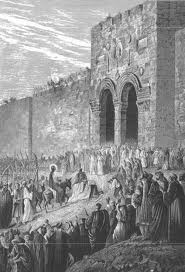
Recorded in all four of the New Testament gospels, is the event of Jesus riding on a donkey, as he entered the city of Jerusalem (the City of Peace … ironic don’t you think, that a City, so very mired, today, in conflict was named a city of peace? … but, I digress).

Some in the crowd laid down their cloaks for his donkey to walk on (maybe this was the first red carpet event in history?), some in the crowd waved palm branches as he went by, and many called out, “Hosanna (meaning ‘save now’) to the Son of David! Blessed is he who comes in the name of the Lord! Hosanna in the highest!” (Matthew 21:9)

This all happened as the festival of Passover was beginning. Exodus 12 tells the story of the original Passover (Passover). The Israelites had been enslaved by Egypt, for many generations. God instructed Moses to have His people slaughter lambs, and cover their door frames with the blood. Then, in the night, the firstborn of every family would be killed, except for the households whose door frames are covered in the lambs blood, because the destroyer would ‘pass over’ those homes (this was the final of the ten plagues used to convince Pharaoh to let the people go). 

Moses did as God asked, the Israelites obeyed, and the Passover story came to be. Even in the home of Pharaoh, the firstborn of every Egyptian household was slaughtered. But the people in the homes that were covered by the blood of the lamb, were spared, and Pharaoh set the Israelites free.

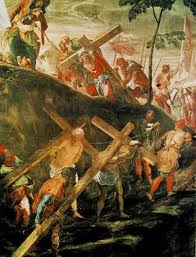
Later this week, on Good Friday, in churches all over the world, talk of a parade will be, again, paramount. Again there were crowds of people. Again there was shouting. This time, there was no “Hosanna”, there was no ‘save now’, being sung out. Instead the shouts were “crucify him.” This time it was all a parody, all a mockery of the earlier parade.

Each of the gospels mentions his walk to Golgotha (the place of the skulls), where Jesus was nailed to the cross that he and Simone of Cyrene carried there. That walk, that parade, was after being wrongly tried, convicted, flogged, and had a crown of thrones pushed onto (into) his head.

This parade was the parade of the lamb of God (the Son of God) to the slaughter. And his blood, shed for all of humanity, is what sets us free.

“And when your children ask you,
‘What does this ceremony mean to you?’
then tell them,
‘It is the Passover sacrifice to the LORD,
who passed over the houses of the Israelites in Egypt
and spared our homes when he struck down the Egyptians.'”
Exodus 12:26-27

Watch the Lamb


Read Full Post »

Screen Shot 2018-03-21 at 11.07.08 AMWhat is the meaning of life? What gives meaning to life? What makes life meaningful?
Those are the questions of a life … my life … at forty-nine years into this life.

We look forward, we look back, realizing that once that which was was forward, is now back. Tomorrow, this day will be past. The clock ticks, the calendar flips. Our inhales are the past as the freshness of that breath is exhaled. Our days move so slowly, looking forward, so quickly, looking back.

“You don’t know what will happen tomorrow.
What is life?
You are a mist that is seen for a moment and then disappears.”
James 4:14

You are a mist …

If my life, if I am a mist, than what can any of us accomplish or do for anyone, for this world, for our God?

Yet, as I awakened this morning the grass was damp with a mist-like dew, giving me more margin before watering the new seed in the ground. That mist-like dew, watering and giving life to that seed that I spread … that dead seed, hard and lifeless. That mist-like dew, bringing breath back into that hard shell, reminding it who it is, who it is meant to be, what it’s job on this Earth, in this Earth, is to do.

I am to be more than just a mirage in the dessert.

So, if I, if my life is a mist, that is seen for a moment (a morning) then disappears, I guess all I am required to do is water, bringing life to that, to those who have been hardened by their circumstances, beat down by the winds of life, brining refreshment and hope to those who think there is no more hope.

I don’t think I do that every day, I know I don’t, yet I know people who have done that, who do that for me. People who love and care and water my soul each and every day. People who encourage and inspire me. My family and friends who show love with their hugs, warm words and laughter. People who are really real, and who open the door that others, that I, can be really me.

So, I am a mist … may I bring relief.

Read Full Post »

Screen Shot 2018-03-20 at 8.18.25 AM.pngAs the Spring Break is underway for myself, and others, in my neck of the schooling woods, we get to also take in the signs of Spring.
Already I have examined the bulb plants growing, daily from their warming soil, Magnolia trees with flower pods getting heavy, the Forsythia blossoms starting to peek out, and buds on every tree. Even the grass is starting to dart up.

The gardening stores and nurseries are becoming the hubs of spring seekers, Seeds are being started, colour being added to the beds, pots and gardens. New gloves and clippers purchased to replace the broken and missing (no doubt to be found only days after new ones purchased). The blades are being cleaned and sharpened for trimming.

We breath in the air, fresh and clean, reviving our senses, our imaginations and dreams.

There is no sweeter start to any season. In a sense, spring is a sanctuary … a season of rebirth, renewal. A season of wide-eyed excitement and wonder. A time apart from the day to day of the rest of the year.

It is no coincidence that Easter also falls in the spring of the year. It, too, is a season of renewal, a season of wide-eyed excitement and wonder. It marks the end of waiting for the risen Messiah.

It reminds us that he rose once … that, like the crocuses, tulips and daffodils, he will rise again.

“Let not your hearts be troubled.
Believe in God; believe also in me.

In my Father’s house are many rooms.
If it were not so,
would I have told you that I go to prepare a place for you?

And if I go and prepare a place for you,
I will come again and will take you to myself,
that where I am you may be also.”
John 14:1-3


Read Full Post »

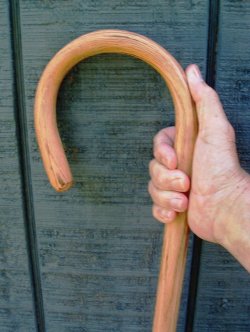
staff

I have a love-hate relationship with our property.

When we first bought it we did so knowing that we would need to pour blood, sweat and tears into the property, for it was a visual disaster.

Almost fourteen years later, we are still bleeding, sweating and the tears are ever-flowing.

Much our time here, I have hated what it has taken from us, in terms of money, time and energy. Now, as we are preparing the property to sell, I find myself looking around at all that we have done, at how it is now looking as we had dreamed, and bemoaning the fact that we are about to leave it, for someone else to enjoy.

I have found my longing thoughts to be interrupted by a whisper in my mind,

don’t hold too tightly to the things of Earth

It was then that I remembered a speaker once talking about the staff that Moses carried.

Moses was a shepherd, and his staff was the tool of his trade. It was what helped him in protection of his sheep, but the staff would only do it’s job when under his control.

When Moses met God in the burning bush, “the Lord said to him, “What is that in your hand?”
“A staff,” he replied.” (Exodus 4:2)

I am pretty certain that God knew what was in Moses hand, but, I think, he wanted Moses to acknowledge it as it was, a staff, a tool when in his expert hand.

God gets Moses to throw down his staff, and God shows him what his staff can do when it is God who is in it’s control.

Later in the passage, we learn that the staff of Moses is to become the staff of God: “take this staff in your hand so you can perform the signs with it.” (Exodus 4:17).

And he does. That staff, once the tool of Moses, is transformed into a snake, plagues, splits the Red Sea, and helps the Israelites defeat their enemy, when under the control of God.

The thing is, for God to operate that staff, Moses had to throw it down and allow God to take control …

he had to loosen his grip.

Whatever we are holding onto, if it can be used by God, he will leave it in our hands, if not, he will still use us in ways we cannot even imagine.

What is in our hands that God is asking us to throw down? loosen our grip? let go? If we can trust him with our souls, surely we can trust him with the things he has provided.


Read Full Post »

« Newer Posts - Older Posts »

Lessons from a Lab

From My Daily Walk with the Lord and My Labrador

From The Darkness Into The Light

love, christ, God, devotionals ,bible studies ,blog, blogging, salvation family,vacations places pictures marriage, , daily devotional, christian fellowship Holy Spirit Evangelists

Karla Sullivan

Progressive old soul wordsmith

Becoming the Oil and Wine

Become the oil and wine in today's society.

I love the Psalms

Connecting daily with God through the Psalms

Memoir of Me

Out of the abundance of my heart ,I write❤️

My Pastoral Ponderings

Pondering my way through God's beloved world

itsawonderfilledlife

FIXING MY EYES on wonder in everyday life

Perfectly Imperfect Life

Jesus lovin', latte drinking, dog lovin', Kansas mama and wife.

What Are You Thinking?

I won't promise that they are deep thoughts, but they are mine. And they tend to be about theology.

Sealed in Christ

An Outreach of Sixth Seal Ministries

Amazing Tangled Grace

A blog about my spiritual journey in the Lord Jesus Christ.

Following the Son

One man's spiritual journey

Fortnite Fatherhood

A father's digital age journey with his family and his faith

Forty Something Life As We Know It

I am just an ordinary small-town woman in her forties enjoying the country life. Constantly searching for wisdom on a daily basis.