I sat in the balcony of the sanctuary when I heard the words that brought tears to my eyes …
“God, we ask that You would lead us as we prepare and plan for the worship service this coming weekend …”
On a Wednesday morning, as my student and I were working together, in a church that has opened it’s doors to a work experience placement, I encountered the heart of preparing for worship.
Preparing for worship is often misinterpreted.
It can be misinterpreted as being only about the music.
wrong
It can be misinterpreted as the sermon.
wrong
It can be misinterpreted as the offering.
wrong
It can be misinterpreted as:
the prayers prayed
the communion taken
the announcements made
the people who do the leading
etc.
etc.
etc.
Preparing for worship can be misinterpreted.
To prepare for worship is to prepare the heart …
The heart of those preaching, teaching, leading the service, leading the music, praying, serving communion, taking the offering.
It is through prayer that each individual associated with worship is prepared. Heads bowed, knees bowed, heart, mind and will bowed to the One we worship. It is not our worship service, it is His … And He is at the center of it.
It is through prayer that ALL who come to worship are made prepared.
It is not just the pastors (although that is essential), it is not just the music teams (although that is essential), it is not just those preparing and serving communion (although that is essential).
It is through prayer that ALL who come to worship are made prepared.
It is through bowing down that we might be lifted up.
“Come, let us worship and bow down, Let us kneel before the LORD our Maker.”
Psalm 95:6
For the next week, I will be featuring guest posts, as I spend my regular ‘writing time’ preparing for a speaking engagement. If you feel led to pray for me in this regard, I would so appreciate it, and specifically that Pinterest does not pre-occupy my writing time 😉 … I am so weak!
After the rains, when the sun’s rays were shining across my back garden, I made a mistake …
a big mistake!
I slipped on a pair of shoes, and walked out to see what was emerging through the sun-warming soil.
I was looking for wonder, but what I found was wallowing.
As I walked through the calf-high (not a baby cow, although I am trying to shed a few pounds) fresh spring grass (that needed to be cut three weeks ago …), wonder began to fade. My garden is growing, and it needs my attention.
But, alas, the bills need to be paid, the kids need to be driven, the meals, the laundry, the demands …
What I needed was a week off work to get caught up on the things of house and home … or a different home, with a small garden.
I began slouching, feeling the weight of maintaining our ‘stuff’, losing wonder and wallowing in self pity.
Then I came inside, and sat at my computer to write … writing can force me to move my focus to less Earthly, more heavenly things.
I opened YouTube, to research the lyrics of a song I had been hearing more lately.
The writer of this song is Jared Armstrong, previously of Desperation Band, a worship leader and song writer. It has been recently recorded by Philips, Craig and Dean, and is playing on Christian radio increasingly as it’s popularity rises in churches and homes.
Jared says this song came from a desire to be a part of the action of worship …
that the baggage of this life would fall away …
it is just about God’s story, not his/our own stories.
He spoke of wanting to not just stand on the sidelines of worship, distracted or disengaged.
As I listened I felt the weight of my Earthly responsibilities, my garden, my stuff … fall off, relieving me of the heaviness that comes from allowing myself to be heavy laden.
I felt stripped of this world until I was naked and unashamed, and drawn in to God’s story … free to dance naked (like David, so many years ago) in the garden of my Creator.
“This song brings back the desire to be connected to the greatness of God.”
Jared Anderson
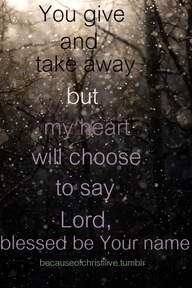
“My heart will choose to say Lord, blessed be Your name”
Worship is a beautiful, action to participate in … in the sanctuary, under our roof, out in the open of God’s creation.
Some days our worship is ritualistic … I do it because I should.
“When I’m found in the desert place”
Some days our worship is intimate … I do it intimately, even in a crowded room.
“In the land that is plentiful”
Some days our worship is robotic … I do it, hoping the outward becomes the inner.
“When the darkness closes in”
Some days our worship is joy-filled … bursting from every cell in our body.
“When the world’s ‘all as it should be”
Some days our worship is loud and proud … I do it with a party in my soul.
“Where Your streams of abundance flow”
Some days our worship is silent … I am a face in the crowd, but I cannot open my mouth.
“On the road marked with suffering”
Some days our worship is against our will … through the clenched teeth of an angry heart.
“When the darkness closes in, Lord”
Some days our worship is saturated by the tears of our heart.
“Though there’s pain in the offering”
Worship is not limited to where we are, when we are there, who we are with, how we feel or the circumstances of our lives at that specific time. Worship is an act of love, respect and honor and it is received as that. Worship is good when things are going well, but it is even better when we can worship our Creator through times of difficulty, suffering and pain.
As I sang the words,
“You give and take away”
It, that which I lost, that which I loved, came clearly into my mind, and for a moment the sorrow of loss weighed heavy on my heart. For a moment that common heart response emerged into my thoughts … why?
When we lose something we love, when our life takes a u-turn, when plans change, and loss is what we feel most profoundly, it is then that why comes crawling back. The word without a consoling response. The word with no bandage effect. The word that causes festering, more pain, more sorrow.
Then came the next line, the one with the salve that gives healing, comfort, consolation …
“My heart will choose to say Lord, blessed be Your name”
To choose to say, in the pain, in the suffering, in the darkness, in the sorrow, in the loss,
Lord, blessed by Your name
That is the only covering bandage that will make what is lost to not be the end of the story.
“Naked I came from my mother’s womb, And naked shall I return there. The Lord gave, and the Lord has taken away; Blessed be the name of the Lord.”
“And you will hear of wars and rumors of wars. See that you are not alarmed, for this must take place, but the end is not yet.” Matthew 24:6
I do not know all that is involved in the meaning behind the passage above. Wars and rumors of wars have been taking place almost since Adam and Eve first ate of the fruit that they were instructed not to eat.
Today is Remembrance Day (Veterans Day, Armistice Day) a day that brings a watery-eyed stare to the eyes of veterans, a day for those of us living in peace and freedom an opportunity, not to glorify war, but to thank those who sacrificed for the gift of peace and freedom.
There is nothing like hearing the stories of freedom attained during WWII as the Canadian soldiers (and others) marched into Holland, or the stories of Jews who survived the Holocaust, because of the freedom attained through the lives of others, to push me to a cenotaph on November 11 … it is the least I could do.
Soldiers are not warmongers, they are men and women who are called to give … give their time, their youth, their will, and even their lives. They are fulfilling not a desire to kill, but a desire to prevent others from being killed, abused, demeaned, disrespected. They are fulfilling their job, as instructed to do so.
But it does not mean that those with whom they are enemies in wartime, are enemies in times of peace.
My family and I are blessed to see the redeeming work of God every Sunday, just by going to church. You see, the make up of our church is something that only God could do, and He has done it so well. On any given Sunday our sanctuary is filled with individuals from all over the world. And, in the pews sit many veterans … Canadian, German, and (until recent years) Russian … wartime enemies, peacetime friends.
I struggled with locating a ‘guest post’ for today. I so wanted something that would be meaningful, respectful, honoring.
So, in light of my earlier words about freedom, I want to introduce you to Neil Wilkenson, a British Gunner during the Falkland War, and Argentinean fighter pilot Mariano Velasco. During this war Neil shot Mariano’s plane down, and has been dealing with post traumatic demons ever since. In an effort to find inner peace, Neil wanted to find out what happened to the fighter pilot he shot down. This is the story of their reunion, and the freedom that was found by these wartime enemies.
In the words of Neil, “the welcome was everything I had thought of, no thoughts of hatred, nothing but pure admiration for each other and as former professionals we both understood it was our duty to carry out what we had against each other back in 1982.”
The guest post today is from a blogger I have guested here not that long ago. This particular post made me consider how important it is to be aware of the movements and trends in society when we are involved in a church.
This Holy Soup post by Thom Shultz discusses the ‘Seeker Sensitive’ movement in churches in the last generation or more.
After reading this post I did a little research, and learned a few things about this movement that I did not know before. For instance, the seeker sensitive movement has been closely associated with the mega-churches, primarily in North America, who have modeled their worship services on other ‘entertainment’ that interests society as a whole, as a means of attracting non-church-ed people.
What I did realize about the seeker-sensitive movement is that of the desire to make church appealing to those for whom going to church is foreign.
This is not a bad thing, not at all! Certainly if someone enters the doors of a church they should be warmly welcomed, not looked at from afar with curiosity. No visitor should enter the doors of a church, and leave afterwords without someone at least greeting them. After all, as Christians, we would all agree that our purpose is the Great Commission (the instruction from Jesus to spread his teachings to the world), and we really cannot do that without relationship. How fortunate we Christians are when that world walks right through our doors.
What this post from Thom Shultz is saying is that maybe their are fewer seekers than we previously thought? Maybe we have created and re-created our worship for seekers who are no longer seeking?
Personally, I think our world will always have seekers. In the words of the French mathematician, physicist, inventor, writer and Christian philosopher Blaise Pascal, “there is a God shaped vacuum in the heart of every man which cannot be filled by any created thing, but only by God, the Creator, made known through Jesus.” And that “God shaped vacuum” will keep people seeking … they just might not be seeking in churches.
I am not an expert in grammar, and that is no surprise to anyone who has ever read even one of my posts!
One thing I do know (not as a grammar expert, but as a Christian) is that worship is a verb, it is a ‘doing’ word. I’m not just making reference to my head knowledge of the word worship, but the knowledge that comes from living with a mind and body and heart and emotions that ‘do’, without conscious thought, when worshiping.
I love to go to concerts of Christian worship musicians, because they provide hours of opportunity to not just entertain the concert goers but also to participate in the worship they are leading. There is nothing that drives my inner worshipper more crazy than when church worship becomes entertainment, and I have to sit still while someone else is worshipping solo …
When I enter into a place of worship (my back garden, my kitchen, the beach, my bedroom, on my favorite trail, and even in a church sanctuary) I am often unnerved by how my inner self responds to what is around me. My senses drink in what I see, what I smell, what I taste, what I feel, and I am led into a spontaneous act of worship. I have no control on this happening, it is my insides wanting to burst out.
I feel a little about worship, like Olympic runner Eric Liddell said of running “when I worship (run) I feel His pleasure.” There is a connection to my Creator that is so deep, so innate in a way, that I have little to do with how I respond to the opportunity to worship.
And that opportunity is constant, and often surfaces without warning. As I have grown I have heard of people talking about preparing for worship, which is a good idea. It is not always easy to settle into worship when you’ve just arrived at church having had the equivalent of battle royale with your toddler to get their shoes on, or had a disagreement with your spouse (which of course NEVER happens in our house ;). But I find that most times when worship begins, the magnetic-like force within me pulls me into God’s presence, whether I am prepared or not. This happens not just in a church sanctuary, but some times when I am weeding, or taking a walk, or standing on a beach, or holding one of my loved ones.
J.I. Packer said, “we need to discover all over again that worship is natural to the Christian, as it was to the godly Israelites who wrote the psalms, and that the habit of celebrating the greatness and graciousness of God yields an endless flow of thankfulness, joy, and zeal.”One cannot read the Psalms and not see and feel the joy that is being expressed.
Worship is an act of celebration, and whether we are participating in a room with hundreds of other worshippers or laying in our bed when we awaken and take a deep breath, it is a party worth celebrating!
“Worship leader George Beverly Shea kidded Billy Graham that the latter would be unemployed in Heaven — while Shea would still have a job leading worship.”
It has been some time since I shared a worship song that I am enjoying, but this one has been marinating in my heart and soul for quite a while now.
I first heard it while visiting at my oldest daughter’s church.
It was singable from my first exposure to it (and that, to me, is a good sign … I hate having to sing a song, corporately, that forced me to think about the tune before I open my mouth … just sayin’). It starts out a mix of lullaby and mystical, with a gradual building. It comes to completion as almost a march.
When I got a hold of the lyrics, I was even more pleased. The lyrics of this song are an opportunity for intimate, one to one, worship, within the corporate context. It is a love song to our Redeemer who conquered death, acknowledging His position above ours and the honor due to Him.
This song is, I believe, an original to the local band, Revolution Band, whose home of worship is Christian Life Assembly in Langley, BC. It is definitely worth a listen, in my opinion.
A few months back, my daughter came home with a CD of original songs from the church band, and lo and behold, there was ‘my’ song! So now I can hear it whenever I like, without having to go to YouTube (and the quality is so much better).
It is called “The Call.”
“You’ve called us into light. You’ve filled us with your truth
This life is all we have, and we it live for you
We’re walking now in grace, it’s your name by which we’re saved
Jesus died and rose again, giving victory over death
Every knee will bow, every tongue confess
You are Lord, you are Lord
Together we rejoice, in this love we don’t deserve
Taking on your call, to point the wayward home
Every knee will bow, every tongue confess
You are Lord, you are Lord
Let our hearts now sing of the coming king, Jesus you are Lord
Let our hearts now sing of the coming king, Jesus you are Lord
Let your word alone Earth and heaven formed, Jesus you are Lord
Let the least and lost, you are grace and truth, Jesus you are Lord
With your death you rose overcame the grave, Jesus you are Lord
He who was and is, and who is to come, Jesus you are Lord”
What is genuine worship, and how can we achieve it in our church? That was the final question to discuss at our church retreat this past weekend.
As our small group, among other small groups, discussed these questions I found myself needing to ponder more than to respond. So, I came home, and searched for what the Bible says about worship:
Psalms 29:2 “Ascribe to the LORD the glory due his name; worship the LORD in the splendor of holiness.”
Psalms 95:6 “Oh come, let us worship and bow down; let us kneel before the LORD, our Maker!”
Psalms 99:5 “Exalt the LORD our God; worship at his footstool! Holy is he!”
Psalms 66:4 “All the earth worships you and sings praises to you; they sing praises to your name.”
John 4:23-24 “It’s who you are and the way you live that count before God. Your worship must engage your spirit in the pursuit of truth. That’s the kind of people the Father is out looking for: those who are simply and honestly themselves before him in their worship. God is sheer being itself—Spirit. Those who worship him must do it out of their very being, their spirits, their true selves, in adoration.”
Mark 12 tells the story of the offerings being made at the temple. The wealthy gave large amounts, but a poor widow only gave two small coins. Jesus response to seeing this was “truly I tell you, this poor widow has put more into the treasury than all the others. They all gave out of their wealth; but she, out of her poverty, put in everything—all she had to live on.” Her act of worship was one of faithfulness, and of sacrifice.
King David is remembered in 2 Samuel 6 for his leaping and dancing, animal sacrifices, and celebrating (possibly even naked) as the ark was brought into Jerusalem. When he was confronted by Michal, daughter of Saul, for his embarrassing public acts as a monarch, he said, “it was before the LORD, who chose me rather than your father or anyone from his house when he appointed me ruler over the Lord’s people Israel—I will celebrate before the Lord. I will become even more undignified than this, and I will be humiliated in my own eyes.” (2 Samuel 6:21-22) His act of worship had nothing to do with special clothes, it had nothing to do with “tradition”, it had nothing to do with what others thought. His act of worship was for and before his Lord. He humbled himself, as King of Jerusalem, to acknowledge and worship the king who put him on the throne.
Worship is such a foundational part of my Christian life. It is not just a Sunday thing. It is not just a music thing. It is not just a corporate thing.
For me, worship is similar to how C. S. Lewis described his reason for prayer, “I pray worship because I can’t help myself. I pray worship because I’m helpless. I pray worship because the need flows out of me all the time- waking and sleeping. It doesn’t change God- it changes me.” I do not believe God needs my worship, but He does require it of me, and I fade when I do not acknowledge and worship my Creator and Redeemer.
Alexander MacLaren said, “fruitful and acceptable worship begins before it begins.” I believe that for us to worship, corporately, and for it to be genuine, our worship of God must enter our churches with us. Corporate, church worship is not entertainment, it is the joining of individual worshipers in a common place, to worship a common God. For it to be genuine, corporately, it must be genuine, individually.
There is the true story of a church in England whose pastor believed that they had lost their way in worship, and “the way to get back to the heart would be to strip everything away.” So, this (brave) pastor asked the worship leadership to take a break. He then taught about worship, genuine worship. He taught them that they are not simply consumers of worship, but that they are the creators, the producers of it. Then he (Mike Pilavachi) asked, “when you come through the doors on a Sunday, what are you bringing as your offering to God?”
Then, he waited,
and waited,
and waited.
It got quiet.
It got awkward.
It got uncomfortable.
But, eventually, a most beautiful thing occurred …
spontaneous,
heartfelt,
sincere,
genuine worship.
In the form of prayers,
and scripture,
and a cappella singing,
the people began to BRING worship to the service, and it was genuine.
While this church was learning about worship, their worship leader, went home to the quiet of his bedroom, where he quickly, easily wrote a song of worship to his Lord. Like David dancing in the streets, this songwriter was simply sharing his worship to God, and God alone. It did get shared, and has probably been sung in the streets, as individual worshipers came to understand that genuine worship begins with a heart of worship.
“When the music fades,
all is stripped away, and I simply come
Longing just to bring something that’s of worth that will bless your heart…
I’m coming back to the heart of worship,
and it’s all about You, Jesus” Matt Redman
There is nothing that makes my heart skip a beat like hearing or reading or singing words that seem to grab my ears and yell “we are for your ears, listen!” If I was listening (who doesn’t hear what is yelled?) I would then spend the next minutes, hours and even days pondering them. Turning them inside out, to see if I am really getting all that they say, because I know they are for me and I don’t want to miss one syllable of their message.
I love it even more when those same loudly proclaimed words take me away to a different place in my mind, to a different place in my soul. Sometimes those words will even force me to make time for them.
This happened one day last year (don’t you love it when only a couple of weeks ago can be referred to as ‘last year’?). As I was singing along in church one Sunday we sang a song, and one line, “forgiven so that I could forgive” yelled at me, and it (and the rest of the song) been yelling almost daily since.
It is a song performed (and written) by the group Delirious. The lyrics could mirror the words of David in his Psalms. They recognize the ranking of the one who has sacrificed as higher than any other (to refer to one as his/her majesty is the highest position possible) on the earth. The lyrics speak of thanks, of grace, of love. It is a song of recognizing the redemption made available, and of receiving it in the humility of one who is redeemed.
For us to understand that we are forgiven is, I believe, a concept not easily or quickly learned. Maybe it is because we struggle to forgive others, and in our own struggle to forgive we do not comprehend the forgiveness that is offered to us? Maybe we can forgive others, but we do not forget the original offense? Maybe we have the order of learning forgiveness wrong?
Perhaps it is in being forgiven that we learn how to forgive. Perhaps we cannot fully forgive another, until we have received (and that offer is always there for us) the forgiveness that is foundational to understanding how to forgive others. And maybe, it is a lesson that we keep learning all of our days.
At least once a month I either share a favorite new (or old, or old made new) worship song, or talk about my worship experience, or I talk about the virtues of worship (even when you don’t feel like worshiping God). Truly worship is my hobbyhorse, my obsession, the heart of my (undiagnosed, except by hubby) obsessive compulsive disorder.
One of the things that I love to do when I hear a new worship song that touches me (either by it’s lyrics or it’s tune) is listen to it over, and over, and over again (if you ask our oldest daughter about ‘Shout to the Lord’, she will tell you I turned her against it, due to my excessive overuse of the ‘repeat’ button). By doing this I can really get a feel for the emotions the song makes surface in my life.
The next thing I love to do is research the story behind the writing of the song. This provides deeper meaning from the lyrics on the page, and again allows me to connect deeper, more intimately with it’s message.
Then, finally, I check out how the lyrics fit with what the Bible says. Some songs are full of emotion (much like David’s psalms), some are direct quotes from scripture and some are ‘feel good’ songs (I, personally, do not have a problem with that. I love jellybeans, and do, on occasion eat a few. The problem comes when I lose my understanding of moderation, and eat a steady diet of them).
So, recently, I was checking out the song “Allelujah, Thine the Glory” by the group The Museum (who ‘borrowed’ the chorus from the hymn written in 1863, by William P. Mackay, then added their inspired verses). It is such an easily singable piece of music, with strong biblical theology throughout each verse.
The chorus is also from Psalm 85:6, which says, “Won’t you revive us again, so your people can rejoice in you?” When I was hunting for the story behind this song I came across the following video, in which the lead of the group tells of the inspiration for the song.
It is a story you can hear for yourself, but I asked a few questions of myself after watching this:
What will our churches today do to avoid becoming lifeless and dead?
Can we, this generation of christians, choose to have joy, even in hardships?
Are we willing to do what Christ will ask of us (as individuals, as a local church, as a part of the world’s christian churches), if we choose to say to Him, revive us again?
Can we start focusing on our God, rather than on ourselves, and our petty issues with each other?
For God to have the glory, we, his church need to be revived. But God will not force it on us, we need to choose to get into His word (and start spreading the love that He placed within us).


 and heart and emotions that ‘do’, without conscious thought, when worshiping.
 this past weekend.
 Psalms 95:6 “Oh come, let us worship and bow down; let us kneel before the LORD, our Maker!”
 So, recently, I was checking out the song “Allelujah, Thine the Glory” by the group The Museum (who ‘borrowed’ the chorus from the hymn written in 1863, by William P. Mackay, then added their inspired verses). It is such an easily singable piece of music, with strong biblical theology throughout each verse.











 itsawonderfilledlife